Saturday, September 03, 2011

For Mountain Biking "This Is The Place"


The Park City Point to Point race is going on right now. I’m not racing because I don’t have to. I can ride this terrain, without a crowd, any day I want to. Okay, in reality I’m more likely not racing because it filled up so fast that I didn’t have a chance (6 minutes) but, still, I don’t have to go out of my way to make a trip because I live here, which is absolutely awesome.
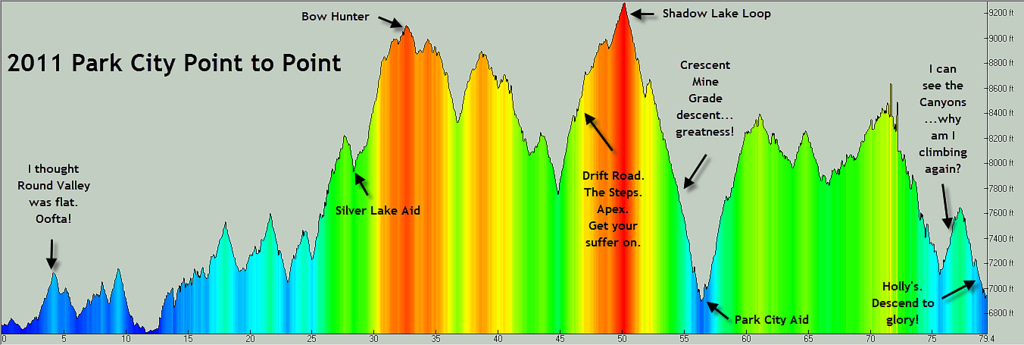

I’m adding a second psyche post this weekend because I leave for Europe soon and may not blog as much, so I’m stockpiling so you regulars will have stuff to read. Anyway, if you like riding dirt and haven’t been to Park City you’ve got to plan a trip. And if you’re type who likes mixing it up on hard terrain plan to register the second next year’s Point to Point race opens because there’s not another event on the circuit like it. Here’s what racer Sonya Looney, who’s done most of the “best” races, has to say.


80 miles, 14,000′ of elevation gain and almost ALL singletrack… and not just any singletrack, the kind that makes the butterflies in your stomach swirl to the point where you feel like you’re going to explode from happiness and you can do nothing by smile ear to ear and giggle out loud. Of course, it’s a race and it’ll also hurt like a mofo.


When I first moved here it was great, so much so that one of Google’s founders, who could live anywhere in the world, chose it specifically because “it’s my favorite place to mountain bike”. This included all the famous places I rattled off: Moab, Whistler, St. George, Durango, Flagstaff, Ketchum, Fruita, etc. For some reason, however, it wasn’t on the radar as a major biking destination.


This could have been because back then we had plenty of pristine single track but lacked a lot of the terrain some of my more adolescent friends enjoy, like rocks and jumps and such. Now we’ve got that too. A lot of it and more, it seems, every day. Yesterday I stumbled on another “grommet trail” as I call them, which are packed with “trail furniture”. It seems like every time I go out I find another.

sam on something i'll never ride

some grommet hucking a 20'step up. there's plenty more where this came from


there's plenty of XC-style furniture as well

Officially there are around 400 miles of single track in the mountains around Park City. Unofficially you’ll find a few hundred more, which doesn’t include the trails systems one the entire west side of the Wasatch drainage, which include many locals’ favorite trails. You’ve absolutely got to check it out.


everything you see is covered with single track


You don’t need a race as an excuse to visit. It’s easy to make up your own adventure, like my friend Ben’s recent birthday challenge; a 10-hour ride that was supposed to feature part of every trail system circling Park City—essentially closing the loop of the Point to Point race to make it a circle (a much longer version of Sedona’s Big Friggin’ Loop). An injury kept us from finishing the circuit as planned but another beautiful thing about PC is that at almost any point, should you get hurt, hungry, thirsty, or just plain tired, you can point your bike down hill and be in a bar, restaurant, bike shop or hospital in a matter of minutes.

you needn't descend, hydration options exist on the trails, too


finnegan is pretty sure this is the place

When I ride here I can’t help think that Brigham Young was right about one thing;” this is the place,” at least to ride a mountain bike.

Friday, September 02, 2011

P90X2: The Next Revolution


For your weekend entertainment, here are a couple of P90X2 teasers. First a short video of Marcus explaining post-activation potentiation to our coaches at the Beachbody Summit—check out his struggle to speak in laymen terms, where he still confuses the audience. Probably would have helped if he’d just said, “the process is to recruit higher threshold muscle cell motor units” like I do in this webinar, where Tony Horton introduces P90X2 with me doing the color commentary. With Tony on stage I always feel like Ed McMahon, laughing down at the edge of the couch. Someone ought to get me a Budweiser (ok, so this jokes a little old, but, seriously, has any talk show second fiddle come close to matching the Carson era?)


P90X2: The Next Revolution (click here for the webinar. It's over an hour pour yourself some Shakeology, or a martini if Ed's inspired you.)

Since the Friday Psyche is provided for outdoor athletes, it’s important for all of you to know that we’ve made a home exercise program that will help you improve at your own particular esoteric pursuits. This program, far more than anything before it, is geared towards improving sports performance more than aesthetics. You are going to want it.

Thursday, September 01, 2011

P90X2 Has Launched!


It’s not quite out, but P90X2 pre-orders start today. As your trainer I advise that you get it. I don’t usually hype our products. I just make them and let that gang in the marketing department decide how peddle the stuff. This one, however, I’m going to harp on you about.

If you follow my blog you’re probably more interested in fitness than the average Joe. And given that’s the case you’re going to want what is, by far, the most advanced training program ever put on video. That’s no knock on anything we’ve done at Beachbody. Most people don’t need advanced. If you’re overweight and hate exercise Slim in 6 is fantastic. If you like to dance you’ll probably love Hip Hop Abs or Turbo Fire if you're a bit fitter. If you need something more advanced we’ve got P90X or Insanity. P90X2 is the next level: movement specific applied science tailored to the masses. If you want to be more athletic, improve at a sport (no matter which one), or simply age more gracefully you’re going to want to own P90X2 at some point.

Instead of presenting you with a sneak preview of X2 like everyone else, here’s some behind the scenes footage. Al Jefferson, of the Utah Jazz, is literally one step away from being an NBA all-star. When he’s on the floor and healthy he’s a consistent 20/10 guy—-Hall of Fame numbers. Unfortunately that step is due to a bad knee. If he can improve the stability of his platform and get his knee to respond to how he’d like to push it, he’ll then be able to back-up his silky smooth throwback post game with athleticism, which will also improve his defense, shot blocking, and rebounding.

This is Al at P3, in Santa Barbara, Ca, where we did most of our research and prep for X2. I saw him during his first trip out, over a year ago. He was covered in sweat, completely destroyed (like me during my first workout at P3), and kind of embarrassed to have others watch him train. Check out Big Al now,doing the same style of training you'll be doing with X2, and keep in mind this guy is a shade under seven feet tall and three hundred pounds. Remember when Shaq could move like this? Look out, NBA!

From P3 (yep, this is the kind of description you’ll be able to use about your own improvement after X2): Al Jefferson is making tremendous gains this off-season at P3...Much of our work with Al has focused on giving him dynamic hip stability, and shifting demand from knee to hip. This process involves both strengthening and neuromuscular re-education of how to stabilize and activate his gluteus medius and upper-third of gluteus maximus.

Wednesday, August 31, 2011

The Great American Nutrient Heist


The final prep before my race has me attempting to shed the last vestiges of extra weight from my body while eating enough to recover from both training and the injuries sustained in a couple of crashes. The key to making that happen is nutrient efficiency, which means that I want to get as many nutrients as possible from each calorie I consume.

This strategy is the opposite of how Americans are taught to eat by the food industry. In an attempt to sell calories as cheaply as possible, Big Food peddles calorie dense, but nutrient deficient, processed vittles whenever they can. Pretty much anything you find in the center of a supermarket (i.e. most of it) fits the bill. From cereals to juices to bread, whenever you see words on a label like enriched or fortified you’re likely evaluating junk food in one form or another.

Most things in boxes or bags are so far from a natural state that there’s hardly any nutrients left in them. Everything we eat has macronutrients (protein, carbs, fat) so Big Food makes sure that this features prominently on the label. But macronutrients only give you a big picture of a food’s energy, not its nutritional content, which comes in the form of micro and phytonutrients. These, in most processed foods, are practically non-existent. So in order for you not to notice these foods get “fortified” or “enriched” with whatever the makers can source on the cheap. Marketers then turn these into “essential vitamins minerals” or something else that sounds catchy, even though they’re almost never added with any forethought about what your body might need to function well. The result is that much of America now must consume more and more calories in order to sustain their body’s nutrient requirements. And you know where this leads; to eating more calories than required to maintain a healthy weight.


“We’re fat because we’re gluttons,” was a comment on one of my recent posts. This is hard to argue. But we’re also being made to eat more than we need by a food industry that won’t feed us nutrient dense calories. Sure, they are also guilty off using additives that make us hungry, as well as crave more of the slop they’re shucking, but they’re doing something even more insidious; filing us up with calories they won’t allow our bodies to function properly. This puts us in a Catch-22, where we feel the need to eat more because we’re lacking nutrients, yet the more we eat the worse we feel.

And this entire scenario was set-up by Big Food. It’s impossible to eat this way naturally. Humans are omnivores, meaning that plants and animals, for the most part, are loaded with everything we need to exist. Natural foods don’t just contain “8 essential” vitamins but often hundreds of different things that our bodies can use—-check out this melon article to see what’s in these fruits often called “mainly sugar” by the uninformed. Granted, poor animal raising and farming practices are chipping away at this, too, but it’s still a lot tougher to make a living organism devoid of nutrition than it is to add nutrients to something that’s been so processed that it begins at zero.

So when I find myself in a situation where I need to lose weight and add nutrition at the same time, I start by eliminating stuff in bags and boxes and making veggies and fruits the cornerstone of my diet. Vegetables are the most nutrient dense food on the planet. And due to their calorie to fiber ratio you can’t over eat them. Fruits, too, are almost perfect and can really only be overindulged when dried or juiced. I then add legumes, nuts, and seeds for their energy and fatty acids and, voila, any extra weight melts away. Five days of this and I’m down to fighting weight, provided I’m in the ballpark when I begin.

My one exception is Shakeology, but it’s formulated in exactly the opposite way of convenience food; to maximize nutrient density. In fact, in a way it’s the foundation of my diet because I’m very busy and it’s the quickest and easiest way to make sure I’ve got all the nutritional bases covered in one fell swoop.


Sadly, my omission includes cans and bottles. As healthy as studies show drinkers are there’s no way to justify it as part of this strategy. As much as it may help your lifestyle it’s simply not a nutritionally dense food. Last night I set a personal record; making it through two episodes of Mad Men with nary a cocktail, or even a beer. And this, of course, is mental training. It’s another important aspect of race prep, but a topic for another time.

Monday, August 29, 2011

Humanely Raised Animals Are Healthier To Eat


I’m a localtarian when it comes to eating meat, which makes me one of those weasely douchebags who drives a Prius, recycles, composts, puts spiders outside and sends his extra shoes to African children. And I’ll live with that label if it means that some animals have better lives because, well, I’ve met a lot of animals and I’m pretty sure they care about having a nice lifestyle as much as people do.

I’m not preachy about it, since we must draw the line at douchebaggery somewhere, but I do champion the fact that animals existing in better conditions are healthier to eat than those that live in the abhorrent squalor forced upon those in America’s Big Meat industry. So I’m pretty pissed off at a PR campaign from the egg industry on a study showing no nutritional difference between the eggs of chickens raised humanely vs. those raised in the poulet version of Devil’s Island. Mainly because the study didn’t show that. It showed the opposite.

next up, a study stating the chickens in this picture are perfectly happy.


I guess when you’ve got lawyers as powerful as Big Meat you don’t let pesky science stand in your way. Fund a study that doesn’t yield the results you want? Fuck it. Just issue a press release to the major wires stating it did. Who’s going to care as long as you’re paying, right?

The Fitness Nerd, that’s who! Big props to Denis, who went the extra mile to scrutinize the science. Not that he needed dig that deep in order to begin finding flaws . The Nerd reports,

So many things wrong here. First off, it's a lie. So much of a lie, in fact, that the release itself admits it 5 paragraphs later when it explains "β-carotene levels were higher in the range eggs, which... may have contributed to the darker colored yolks observed in these eggs during the study."

Huh? How do "no nutritional difference" and "β-carotene levels were higher" mesh? The study indicates vitamin A levels in both types of eggs were the same, yet β-carotene can be converted into Vitamin A in our body, so technically, the body gets more A from the free-range eggs.


But he read the entire study, on principle, and found more problems. So either read his entire post or just believe my anecdotal logic—now based on Big Meat’s own science—which concludes that animals that eat healthy, exercise, breath fresh air and aren’t subjected to Frankenstein-esqe experiments and filled with more drugs than Mr. Olympia are healthier to eat. In turn I promise not to get mad when you call me a douchebag because, in my mind anyway, it’s a lot better than being an asshole like all those wankers at Big Meat. Now excuse me while I ride my fixie to the local farm to make sure they’re letting the chickens get enough exercise.

Friday, August 26, 2011

Which Is Harder?

VIDEO: BD athlete Adam Ondra repeating Chilam Balam (9b) and making the first ascent of La Planta de Shiva (9b) in Spain from Black Diamond Equipment on Vimeo.


The Friday Psyche presents more Adam Ondra. In these two vids we see climbing’s Harry Potter attempt three routes in the running for title of world’s hardest. Does one look harder to you? One does to me but since my chances or redpointing any of them is about as good as me winning the current Vuelta a Espana that I’m not riding it’s not really important. It’s just an excuse to feature a couple more very well made videos that showcase some spectacular rock climbing. Fall is just around the corner. Time to get into climbing shape!

ADAM ONDRA - Working Golpe de Estado in Siurana from BERNARTWOOD on Vimeo.

Thursday, August 25, 2011

The Breakfast Myth


That breakfast is the most important meal of the day is a common saying in the western world. Over at the Fitness Nerd, Denis deconstructs the topic, first coming clean that the slogan originated from someone’s marketing department but also extolling the virtues of eating first thing in the morning. It’s an important read for inquiring minds. So if the title of this post caught you eye, read it first, and then come back for my addendum. I’ll wait.

Is Breakfast for Champions?

There is one flaw in Denis’ piece. The part where he says that I don’t eat breakfast. I do. When I need to. This leads to part II of the topic; times you might want to consider skipping breakfast.

I’m seconding Denis’ post in saying that most people should eat in the morning. If you’re following a sensible nutrition plan you probably ate lightly at dinner and didn’t eat for a few hours prior to going to sleep. This means it’s been 10 or 12 hours since you’ve eaten a meal that hopefully wasn’t carb heavy. And although your body doesn’t burn calories rapidly when its asleep it’s busy repairing all the damage you did to it the previous day. By morning the light dinner is probably pretty well used up. Breakfast allows you to top off your body’s glycogen storage, which is used for physical activity but also brain function, so you’re ready to face the day with a full compartment of nutrients. Sounds pretty smart.

When I have an active day, like a long day out climbing or a race I always eat in the morning, mainly to ensure that my limited glycogen stores (we can only store enough for 1-1.5 hours of hard activity) are topped up. So when I need my body to perform to its maximum I eat breakfast and, in general, follow most of what we recommend in our Beachbody diet guides. However, on my work days I don’t eat breakfast. And here’s why.

I have to begin the previous evening, because I tend to eat close to bed time. This isn’t optimal but it can work (almost any diet can be made to work within the parameters of your lifestyle, which is why Beachbody’s diet philosophy is that there is no one diet that’s perfect for everyone). I eat late because I exercise after I’m finished with work, which is usually later in the afternoon or early evening. If I finish training at, say, dark, then eat (especially if dinner is slow and social), it’s pretty late. My dinner is also, by far, my largest meal of the day. Generally more than half of my calories (again, unless I’m active all day when I eat constantly). So I go to bed still digesting and wake up with a fully tapped glycogen, meaning breakfast simply is not necessary.

Furthermore, going long periods of time without eating teaches your body to be more efficient as using fat for fuel (Denis points this out). As an endurance athlete this function is vital, so I train it pretty much every work day. Furthermore, there is some hormonal advantage to what’s called intermittent fasting. A lot of bodybuilder types are championing this as scripture but the advantages are technically small. Still, it’s more ammo for not eating.

So, anyway, on a work day I don’t eat breakfast. And it gets worse. I get up pretty early, drink some water—usually two or three glasses—and try to do some short activity to awaken movement patterns; easy yoga is my preference. Then I make some coffee (or tea), drink more water with some supplements (no cals but this isn’t a supplement post so not going into it), then sit down with my coffee and get to work. So I have replenished some nutrients, just not calories because I want to keep training the fat mobilization process.

I work until I start to run out of steam, usually a four to seven hour stretch. Then take the dog out for his “morning” exercise. This is usually an easy hike with ball throwing when I also do a functional warm-up (like the warm-up of P90X2) and, depending on the day, some running drills. While this is warming up for the day it’s also further training fat mobilization. I follow this with breakfast, even though it’s “lunch time”. And, yes, your math is right. I often fast for more than 12 hours daily.

I then go back to work until I’m finished, which varies according to deadlines and the training schedule. I do generally have a pre-workout snack, like Shakeology, an hour or two before my training session. And that is my daily eating regimen on work days.

Of course it’s not set in stone. It varies all the time, especially since my job requires that I experiment with various diet, exercise, and supplement protocols. But it’s important to note that there are many paths to success. I’ve been eating like this for most of my life. I’m 50, have a resting heart rate in the low 40s, can push my heart to over 200 bpm, and can score over 100% on the most rigorous military fit test. My strange protocol works and you can certainly find something unconventional that will work for you, too.

My point in passing on this information is for you to question dogma and, more importantly, eliminate excuses. In training, life, and nutrition absolutes simple do not exist other than the rather holistic eat well, sleep well, and get some exercise. Everything else can be adjusted for your personal lifestyle.

Monday, August 22, 2011

Kevin Thaw: A Man For All Seasons

Kevin Thaw interview / entrevista ESPN June 2011 Part 1 from Wild Country on Vimeo.


This week I’m adding a couple of vids for Monday psyche for anyone needing a little more time to ease into their work week. These are of my friend Kevin Thaw, my primary climbing mentor and someone I once spent an inordinate amount of time with. Kevin and I met when I was living in Yosemite in the 80s. He didn’t seem bothered that I was a fledgling climber while he was ticking some of the Valley’s hardest lines, so we started sharing a rope and have been friends ever since.

He’s been one of the world’s best all-around climbers for a long long time. In the mid-90s he was still pretty off the radar so I wrote this article about him in a small magazine me and a few friends used to publish.

Kevin Thaw: A Man For All Seasons

He walked around the Outdoor Retailer trade show, showing it to potential sponsors, and has been a professional climber ever since. These vids are a short recap of his life. Enjoy.

Kevin Thaw interview / entrevista ESPN June 2011 Part 2 from Wild Country on Vimeo.

Friday, August 19, 2011

Ride More. Work Less.

Lone Wolf Matt Hunter from Bike magazine on Vimeo.


Since it’s full on hippie biking season here are a couple of vids for your Friday Psyche. Both are inspiring in one way or another. The first stokes the fire for some overnight riding advenutures and the second makes me happy with most of the choices I’ve made in life. Mainly, they just make me want to get out on the trails on my bike. The weather’s perfect. The trails are in perfect condition. I think it’s time to turn off this machine and do just that. Happy Friday!


Thursday, August 18, 2011

Is Beer Really Better Than Water For Hydration?


Men worldwide were ubiquitously in high spirits (ridiculous pun intended) over a Spanish study that showed that post exercise beer was better for hydration than plain water. Other than in the UK, where beer is almost a religion, the press and scientific community pretty much left this alone. The blog-o-sphere, however, went nuts (tangential pun intended), championing one small study as the most important science since the Dionysian era with subtle headlines such as “There is a God: Beer Hydrates Better Than Water (Seriously)." But, seriously, does it? Let’s take a critical look.

The study

Professor Manuel Garzon, of Granada University, had a group of students to do strenuous exercise in temperatures of around 40ºC (104ºF). Half were given a pint of beer, while the others received the same volume of water. Conclusions showed those who drank beer hydrated “slightly better.”

Conclusions

While not exactly a testament for a pint it does put a kink in the puritanical argument that water is holy and all alcohol is the work of the devil. Also, as noted by some detractors in the scientific community, was that the study seemed a little sloppy, as perhaps the researchers spent a little too much time researching down at the pub to be bothered with dotting i’s and crossing t’s. But regardless of nitpicks a beer-positive was clear, and with more analysis it makes complete sense.


carl , this bud’s for you.


Analysis

Juan Antonio Corbalan, a cardiologist who worked formerly with Real Madrid football players and Spain's national basketball team, said beer had the perfect profile for re-hydration after sport.

He added that he had long recommended barley drinks to professional sportsmen after exercise.


After sport is the key to all of this, especially vigorous sport in hot weather because it makes us sweat more. And sweat, as most of us know, contains body salts referred to as electrolytes. And beer has more of these than water. Furthermore, it has energy (kilocalories or just “calories” if you’re American) in a macronutrient ratio of mostly carbs, a little protein and virtually zero fat. Those of you well versed in the science behind athletic “recovery formulations” know that the above ratio is preferred for quick muscle recovery. This means that beer is closer to Recovery Formula than is water and, thus, it makes sense that it should rehydrate you better after sports.

In fact, a lot of things would probably beat plain water in a post-activity study because your nutrients needs are completely different then when you aren’t active or haven’t exercised--when water is almost always the best choice. Unfortunately for most of the “there is a God” crowd, it means that beer will beat water for hydration after playing football but it’s going to have the opposite effect if all you’re doing is watching football. Sad, I know, and I am sorry.

When you break it down beer has an excellent post-sport resume for quick recovery. Its ingredients—German law until recently—are simple: water, barley, hops, and yeast, all of which are quite healthy, containing electrolytes and a great phytonutrient profile along with the aforementioned macronutrient base. The fermentation process, which we know is how alcohol is made, also has positive effects such as making foods more bioavailable and enzymatically active.

Unfortunately, large American brands are an affront to traditional brewers and use rice as a base, along with various extracts and things sold off from the country’s over production of genetically modified corn and soy—meaning Michelob Ultra should not be your recovery drink of choice no matter how much a certain athlete hypes it.

To further tame the party limits on volume must be discussed. Garzon gave his subjects one pint, which is somewhere in the neighborhood of 200 calories. The post-exercise hydration equation is all based around how quickly your body can put nutrients to work. In the first hour post exercise you will absorb nutrients much more rapidly because your system is depleted. This is why carbohydrates are preferred and fats, which digest very slowly, should be shunned (studies in the 90s showed a 4 to 1 ratio of carbs to protein, with little or no fat, was most effective). Anyway, what you need is energy that can be put to quick use. Your body can only turn around (digest and put to use) somewhere between 200-300 calories in a given hour. So anything more than 300 calories in the first hour (250 is a more accurate for most of us) will slow nutrient absorption and reduce the effectiveness. This means one beer, or maybe two smaller beers, are the maximum you can consume for a net positive recovery effect.

I’ve yet to discuss alcohol, which is a diuretic, meaning that it would naturally hurt hydration. But because beer is mainly water if you follow the above volume limits it’s not much of a factor and if you’re interested in nitpicking there are better options available.

Conclusion

While not as effective as Recovery Formula, a pint of real beer after hard exercise will outperform water, and many other things, for recovery. Cheers.

pic: ben and i, clearly worried about micronutrient replenishment and enzymatic activity somewhere around hour six of a ride.

Tuesday, August 16, 2011

Non-Race Report


After crashing hard on a ride Sunday it now seems official that my only races this year will a state championship, national championship, and world championship. I guess if you’re going to race you might as well go big. I will also add that this is not the best way to prepare for racing, especially if you’ve any interest in your results.

It wasn’t meant to be like this. At the beginning of the year my calendar was filled with preparatory races. Duathlons are scarce in my part of the world but I travel a fair amount so it didn’t seem like such a task to run into a few here and there. However, my work and race schedule’s never synched up and the closest I found myself to a duathlon on any given weekend was a nine hour drive. I’d also circled some tris, runs, and bike races to do and none of them worked out either.


Other than Duathlon Nationals, which I had to do in order to qualify for Worlds, the only race I made it to was our mountain biking state championships. This had nothing whatsoever to do with prepping for multi-sports. I only entered this race so I could qualify for nationals, visit my friend Rebecca, and ride all the trails she’s always going on about. I did manage to qualify, traveled to Ketchum for the event, which leads to this installment of the non-race report.

biketown.


The non-race report requires some back story. Cycling and triathlon teams have tradition where the best placed rider on the team writes up a race report and submits it to the team mailing list. During the end of my race-every-weekend stint as a road racer, when I missed a long stretch of races for strange, amusing, and downright lazy reasons, I submitted a “non-race report” that seemed to entertain the lads as well help them not feel bad about calling early on a race morning to make sure I’d show up.

reed on a night where we probably weren't making the races in the morning.

Most of these tales included my friend Reed. We were on the same team we lived an hour apart. This meant that it generally made sense to stay at whomever’s house was closest to the next day’s race. And this led to a series of last-minute decisions about things to do that might be more fun than riding our bikes in circles as fast as we could. These might include an epic road ride, a long climb we’d been wanting to tick off our list, a casual group ride that was supposed to be attended by cute girls, mountain biking, rock climbing, or simply a long night of drinking and socializing leading to us wanting more sleep. The first few excuses were legit but, after a while, we decided that it really was more fun to just ride our bikes on our own time than it was to race. I haven't raced much since.

who looks like a pig?

yep, biketown.


So I’m in Ketchum, a few days before Nats, and not exactly tapering. In fact I’m trying to ride as many of the classic local rides as possible before the short holiday is over. I’ve got two races on the schedule, neither of which I care too much about. The morning of the first race I head out early to pre-ride the course, and crash. Hard.

reba got this call while we were at breakfast. it's mountain biking. sometimes you crash. at least my crash didn't turn out like this.

It’s a stupid crash because it’s on a part of the course that I’d already determined to run because Rebecca told me it would be much faster. But I’m going slow and warming up and just want to see if I can clear the obstacles. I don’t preview anything and one second I’m hopping over a tree and the next I’m doing cartwheels down a mountain side. I’m shocked, because it looked rather innocuous, but if I’d bothered to glance at it beforehand I would have seen a root shooting out from the back of the tree that was like a small ramp leading off of the trail. I’m pretty bloodied but everything seems to be working so I ride the rest of the course and then head to breakfast. The next morning one hand would be too swollen to grab my brakes—and is still bothering me a month later—but that’s an aside.


A little later, Finnegan and I begin a nice long and slow warm-up for the race. Norba (now USA Cycling) races are short (usually 10-20 miles) and ridiculously fast out of the gate. They are hard to warm-up for because the first few minutes are absolutely full gas. Since I often settle in about hour three (too much enduro stuff over the last decade) I decide to warm-up for an hour and a half; riding aerobic for most of it and putting in a few hard efforts to “open the pipes,” as cyclists say. This also doubles as a workout for Finn and allows me to preview another classic trail.


At some point along this trail thoughts of the long-forgotten non-race report start to trickle into my head. The trail is great. It’s empty. We’re surrounded with quiet, just a few mountain sounds, and jillion-dollar views. I hit the end of my warm-up and sit down to have a snack. I can faintly make out the race announcer, far below, and picture the mayhem of 100 guys all redlining to be first into a dusty stretch of singletrack. I look in the other direction, where empty trail stretches forever into a mountain range I’ve yet to visit. Finnegan has never looked happier. I ask his advice. Needless to say, the non-race report is alive and well.

at this point there's only one rational decision that can be made.


Friday, August 12, 2011

Meeting the Tarahumara


This week’s psyche post is from Micah True (aka Caballo Blanco), who was made famous by the book Born to Run. This is the true story—as opposed to the hyperbole-ized book version—of how he met the Raramuri people of Mexico who he’s been intricately linked with ever since. It’s a great read that will motivate you to get out on the trails even if you aren’t a runner. Click on the excerpt to read the rest:

"Well, shucks; I really want to run this race, and am an old time, loyal friend of this event; won't you let me enter?" I had pleaded with the race director, who did not even remember my name, or who I was, even though I had run the "family'' like race four times. No chance; the race had grown big now, and entry was at a premium. The "New York Times" and many publications had written the story of the 55 year old Mexican winning the race. Leadville was now a huge spot on the ultra-running map! The race and their corporate sponsor, a shoe company, had benefited considerably from all of the publicity, the feel good story of the impoverished Indians running for their communities; and not JUST running, but winning; and a 55 year old in sandals at that! A deal was made with the 'gringo' promoter who had driven the Tarahumara north, to bring another team of seven Raramuri to the '94 race. I think that part of the deal was to wear the race-sponsor's shoes for a photo op.

I received a phone call from the gringo sponsor/promoter of the team of Raramuri. He was looking for help, someone who could run and knew the course, to pace some of "his" runners. "Sure, I'll do it, providing I can run the whole 50 mile return with the runner of my choice." "They tend to run faster as they go; you think you can keep up?" he challenged. "If I can't keep up, then they don't need me," I confirmed...


CB and his dog, Guadajuko, and at the start of the race he organizes each year, The Copper Canyon Ultramarathon.

Thursday, August 11, 2011

How To Treat (and Avoid) Plantar Fasciitis


Here’s a decent little video on what plantar fasciitis is and how to treat it in its acute phase. What it doesn’t cover is how to get rid of it or, better yet, prepare your body so that you don’t get it in the first place. Once you get it there’s no way around a fairly lengthy rehab process and it’s not all that hard to avoid. Here are a few exercises that, when done regularly, will greatly reduce the chance of you getting plantar fasciitis. When you have it, these are also your go-to movements.

A,B,Cs: I hate it when doctors prescribe this exercise as a treatment for foot injuries. Not because it’s bad but because once you have foot issues you must get more aggressive with your rehab and this tends to get prescribed the most only because it’s simple. All you do is draw the alphabet with your feet in the morning before getting out of bed. If I’m spending a lot of time on my feet—like when I’m running ultras—I’ll do the alphabet both forward and backwards, slowly. It’s a great warm-up for your feet prior to getting out of bed.

In and outs: While A,B,Cs are a great warm-up, you need to strengthen all the muscles of your foot and ankel so that it doesn’t collapse, which is probably how you got PF in the first place. This exercise can be done anytime and anywhere. Sit with your legs parallel about two fist widths apart, feet flat. Rotate your toes inward as far as they can go, forcing your weight onto the outside of your foot. Now rotate out as far as you can go, forcing weight onto the inside of your foot. Do 50 reps daily until this is easy. Then you only need to do it once in a while to ensure you haven’t lost your strength.

Towel Crunches: I use a hand towel (wash cloth). Sit as above with a small towel on the ground in from of you with the edge under your toes. Use your toes to crunch up the towel as small as you can get it. Then use your toes to flatten it back out. Do 25 if you can. If not, that is the benchmark of strength you are looking for.

Toe raises: Stand with your back flat against a wall, feet together, flat on the ground, out in front of you about a foot or so. Now raise your toes while keeping your back presses flat against the wall. This works the tibialis anterior muscle on the front of your leg, which helps balance flexor/extensor leg strength and will also keep you from getting shin splints. Do 50 a day until they feel easy, then do them once a week or so for maintenance.

Wednesday, August 10, 2011

26er vs 29er


If you’re one of those who still isn’t sure what size wheels to ride on the dirt you must check out this video. I’ve been a 29er convert since the first time I got a leg over one because it just felt right. I was never sure whether or not it made me faster but I was certain that it’s more comfortable and, hence, more fun. There’s no doubt you can feel some advantages with smaller wheels but you’re never really sure if it’s faster or just feels that way because you’re covering less ground on each revolution. In this video professional racer Christoph Sauser sorts it out once and for all.


the most definitive comparison in wheels size is best tested rigid, which will leave you wondering why anyone would ever bother making a 26 inch single speed.

Tuesday, August 09, 2011

A Realistic Training Template For a Busy World

I can’t believe that it’s only four weeks until I leave for Europe. The final phase of my training program has snuck up on me like a ninja in what’s been a chaotically busy summer. But that’s life as a recreational athlete. Every day doesn’t revolve around training. Training comes down to what I can fit in around everyday life. And this is the case for, like, 99% of the people I work with. And one of the major keys to success is getting them to adjust to the fact that their training schedule is a proposal, not game where one wrong turn means that you lose.


Last night I drew up my template for my final prep for Worlds. It’s a guideline for the volume, intensity, and amount of recovery I think I need to be ready for the race. But it’s only a logical proposal based on science. It’s not a daily schedule, even though it looks exactly like one. My realistic goal is to tick off what’s on the plan, and follow its structure, within the constraints of life. This means that my training log will probably look a lot different than what’s written here, but should yield the same results as long as I stick with the principles reflected in the schedule.


I’m writing this because rarely does a day go by when we don’t hear questions from customers who think that if they deviate from their workout schedule all of their hard effort will instantly disappear. We even stopped using suggested days on our schedules because we got so many “if I do Chest & Back on Tuesday instead of Monday will P90X still work?” type of questions.


Training is not magic. It’s not a game or a trick and there is no on and off switch. Our training schedules follow logic and are very important—as is the template I made last night—but only as a guideline. You need not follow the schedules to the letter to get results. You need to adhere to the principles to keep training hard enough, give yourself enough rest between similar workouts, and not over train and hit a plateau. Doing a Turbo Kick class at the gym instead of HIIT 20, a company softball game instead of Kenpo X, or going a little overboard at your friend’s wedding… it’s all just nitpicking. Success comes from training hard, seeing your program though to its end, then finding a new challenge to keep you moving.


The schedule here is my race-prep training only. Not listed is my mobility work (yoga, stretching—at least a short session daily), weight training (one PAP session per week for the next three weeks), prehab/rehab/core (2x/week), and climbing (Worlds are in Spain so climbing is definitely on the agenda—2-3 short sessions per week).


Friday, August 05, 2011

The Juice Movie: Psyche and Skepticism


This looks like a nice, inspiring film that will probably create a very minor juice fast craze. And that’s great. People should juice veggies at home. I do it all the time. I also hang out at a juice bar/coffee/bike shop so much that I could get mail there and no one would bat an eye (that incidentally bought their juicer from Whole Foods who now uses concentrates in their smoothies, so don’t buy them). The star seems like a funny guy, the show is filled with information that everyone should know, and I love the angle that it’s how you feel, not how you look, that ultimately matters. I’ll give it a thumb’s up based only on a preview. So where’s the skepticism?

I can see the excuses already. I can’t afford a juicer. I can’t juice fast with my job. All liquids but soda make me sick (an actual Message Board excuse), etc. The lesson many people are going to take away from this film is going to be that you must either juice fast or be fat. We are a country that, for some strange reason, sees the world in black and white terms. And nothing could be less black and white than nutrition because there are many different healthy ways to eat.

Somebody mentioned to me recently that Beachbody had a lot of different diet plans. While this is true, as each diet plan uses a slightly different psychological tool for motivation, all of our “different” plans end up doing the exact same thing; transition you away from junk food so that your diet consists mainly of whole natural foods. It’s all very simple and we have millions of success stories to show it works. You don’t need juice. You don’t need eat like a caveman, a French woman, Aphrodite or Dr. Phil. You don’t need to stay in a zone or pretend you live on The Riviera.

The only black and white thing about nutrition is the cause of the obesity epidemic. We eat too much crap. And we don’t exercise very much. If you change those two things you will stop being fat, you’ll get sick less, and you’ll feel good most of the time. The real solution is a lot simpler than even dumping veggies into a blender. Not that there’s anything wrong with that.

Wednesday, August 03, 2011

Why Overtraining Isn’t Always Over Training


If I ever lose my mind and decide to run for a public office would someone please remind me of this post. I’m a terribly inefficient socializer. Whenever I spend an inordinate amount of time in social settings I break down, even if my exercise patterns are minimized for the situation. Of course I could just adjust to this, becoming a glad-handing, canned answer man who can waltz through a day of baby kissing without it causing so much as a blip to my adrenal system. I just don’t see the upside to making that switch. I like being engaged in conversations. And I like my alone time. A lot. So remind me. Please. No politics.

The perils of schmoozing isn’t the point of this post. It’s to remind you that overtraining doesn’t necessarily mean that you are working out too hard. You could just be living too hard. Training effectiveness isn’t all about bringing it. It’s about balancing your training with your recovery, which takes into account diet, daily activity, and sleep. Lose any one part of this equation and risk becoming overtrained, even if all the exercise you’re doing is based on recovery.

This topic came up again and again in many various forms on last week’s Chairman’s Adventure in the south of France with Team Beachbody's top coaches. It was presented in the form of discussions on jet lag, post workout nutrition, pre-workout supplements, and the effects of alcohol on your workouts, and on and on. Each topic is worth its own post, which will be coming. Today, my jet-lagged foray back into public writing is only on the big picture perspective as exemplified by me.

I set up my training schedule to finish a hard block prior to leaving on this trip. The week-long biking adventure seemed like a perfect opportunity for some active recovery. In theory it would have been. A few hours a day of casually spinning through Provence is a text book performance recharge, especially knowing that you’ll be well fed. What wasn’t taken into account was sleeping poorly, late night wine tasting, lots of stimulating conversation, the motivation provided by a pace line, a few wrong turns leading to under-fueled hours on the bike, and Monaco’s 24hr lifestyle with Jon’s friends.

non-planned things that can lead to overtraining:


riding harder than you planned.

Dave Ward HAHAHAHA. It's just slightly more complex than that. I sat next to Steve Edwards for 2 hours on a bus ride. If that doesn't fill your head with blog/vlog posts I don't know what will.

engaging conversation


making a wrong turn after one of the world’s most iconic climbs, leading to 12k of climbing you didn't fuel for.

focusing all remaining mental energy on the wines of provence.

four hour explorations of the maritime alpes with only 16oz of water.

enjoying the sunset... til sunrise.


Since you can’t always tell if you’re overtrained I planned a little test; the same ride pre and post trip as a gauge. About an hour into my post-test I knew I’d over cooked the holiday. The punch I had before, even while training hard, was lacking. I’d have to shut things down and lose perhaps a week of World’s training. I was hit with further evidence later that night when I got a cold—the easiest to read overtraining meter there is.

After two days and lots of sleep things are feeling back to normal. I’m bummed to be missing out on the hard training that was on the schedule but keep reminding myself that 1% overtrained is worse than 25% undertrained, or so the saying goes. If that didn’t work I could fall back on how much fun the trip was because it’s always worth missing a few workouts for time well spent with good friends. Anyway, I always expect hurdles along any training program and so should you. Even professional athletes, who are paid to do nothing else, have a hard time keeping their planned schedules on track. And if pros have trouble you might, too. And this mindset will help so that when you hit life’s inevitable bump in the road you don't endo.

Tuesday, August 02, 2011

Historic Big Walls

Hardest of the Alps from STORY.teller on Vimeo.


I should be back to blogging shortly but, in the meantime, here’s a great video of Los Hermanos Pou climbing three of the most notorious big wall routes in the world.

On a health note, my friends and I all marvel at how a company that sells only one moderately-effective energy drink can afford to sponsor so much shit. But at least they’re sponsoring cool shit, so I’ll cut ‘em some slack. I don’t drink Red Bull myself. But if were the type to regularly play through at all night clubs, I would make it my mixer of choice.

Friday, July 22, 2011

Training Weaknesses


It’s not just a cliché to say that in order to get better you must be willing to get worse when it comes to training. And though it’s easy to rationalize on paper it’s often hard to buy into a periodizationl strategy when you’re suffering and not seeing tangible improvement. This has been my July.

A month of PAP workouts, running drills, and short hard efforts on the bike are hopefully improving my power and top end speed but I’m is such a state of breakdown it’s impossible to gauge how it’s working. Re-tooling neuromuscular patterns wreaks havoc on the system and keeps me on edge. I don’t feel comfortable and find myself wondering if I’d have been better off overall to keep training my strengths in a way where I know I’d peak for my race in Sept. As I said at the start of the month it’s a gamble to try this on such short notice and I won’t know how it went until I begin integrating my training in August. At least this hay is in the barn and now I’m looking forward to unwinding with a recovery trip to France with some of Beachbody’s top coaches.


Where I can tell I’m getting stronger is in my PAP workouts. I’m leaping higher and have much better lateral stabilization. Last night I did Asylum Back To Core and Relief as a recovery day and it felt like one—itself an indication that something good is happening. But all this power gain comes with a loss in endurance and, hopefully, there’s time left to bring this back to competition level. Peaking for races is always tricky and it gets even harder when you also attempt to throw in a major body composition alteration.

This is why P3 tries to get as much time with athletes as far away from their season as possible. The longer time period you have to easier it is to make major changes. In these videos are the Utah Jazz’s Derrick Favors and Gordon Hayward. Both showed promise as rookies but need improvement to become household names in the NBA. To get there they’ve been working at P3 on weaknesses since the season ended. In the two examples of PAP complexes you’ll see Hayward jumping off of one leg to try and offset a discrepancy in leg strength, while Favors’ targets lateral explosiveness. Very motivating for those days you aren’t in the mood to bring it--as well as a small preview of P90X2.

Wednesday, July 20, 2011

"One Hell of an Epic"


I’ve got to admit it’s been the most spirited Tour de France in a long time. We’ve seen sprinters winning mountain stages, rouleurs wearing the sprint jersey, and the guy who’s dominated every recent grand tour he’s entered getting dropped on climbs. The race leader is currently an attacker who hunts for stages and claims that he doesn’t train with a power meter, heart rate monitor, or even a speedometer. With only three stages to sort out the overall it’s an absolute crap shoot as to who will come out on top, leading one Eurosport commentator to sum it up as “one hell of an epic”. And to think, when it all began I was ambivalent.

The flat stages have been the most fun. Cav looks as though he might finally hang onto Green but it hasn’t been easy, especially since when the roads have gone up the sprinters have not only hung on to win intermediate points but actually won stages. World Champion Thor Hushovd has been the man of the race, followed closely by Phillipe Gilbert, Tommy Voeckler, the HTC lead out train, Garmin/Cervelo, the country of Norway, and a slew of other guys who’ve been fighting out every mountain, hill, sprint and finale like its life or death. To tune in on the Interweb click here.

The only complaint I’ve heard is lack of early attacking in the big mountains. Long gone are the days when the Postal and Telekom trains would lead into a 20 kilometer mountain finish as though it were a sprint. You don’t ride up L’Alpe d’Huez at 20kph breathing through your nose unless you hematocrit is well north of 50. And, while there’s no way to say doping is gone from the peloton nobody is being called “Mr. 60%” anymore either, leading to my friend Josh’s comment/question, “so, is Thor the only one doping? I’m confused.”


However, it wouldn’t be bike racing without a bit of controversy. Over at the The Inner Ring you see a lot of banter from those a bit more in-the-know, or at least willing to dish dirt, than the TV commentators. Such as this tidbit on how race heroes according to the press might not be the most popular guys among their colleagues.

Then, of course, there’s Lance. Even though he’s retired, this time we think for good, it wouldn’t be the Tour without some further revelations about “the comeback of the century” or whatever other monikers the PR machine heaped on the Armstrong era.

Sunday, July 17, 2011

The Incredible Hulk

BD athletes Kate Rutherford and Brittany Griffith attempt Venturi Effect (IV 5.12) on the Incredible Hulk, High Sierras, CA from Black Diamond Equipment on Vimeo.

The headlines have been filled with plenty to comment on but, alas, I’ve had no time to blog. So instead of getting all hot and bothered about the latest sad news about our health enjoy a little stoke instead. Black Diamond has been making a lot of cool vids lately. This one features my friend Brittany climbing one of the most imposing granite formations in the High Sierra. For an added bonus, check out the one below where Brittany’s husband sandbags here into leading some scary. My wife says “she sounds just like me” which is something to take solace in as a recreational athlete because Brittany is rad.

BD athlete Brittany Griffith climbs at Australia's Taipan Wall and Mount Arapiles from Black Diamond Equipment on Vimeo.

Sunday, July 10, 2011

Oh, My, God

The world's first triple back flip on a bike. My stomach is still in my throat. Think I'll watch it again...

Wednesday, July 06, 2011

The USDA’s Pyramid Scheme


I haven’t ranted in a while but figure all this nonsense about the USDA’s food pyramid, um, plate is a good time to get back in the game. Apparently, at least according to a lot of media sources, making a rational change from pyramid to plate (since, ya know, we eat off of plates) is going to put the kibosh on the obesity epidemic. And while I applaud the USDA’s logic I’m offended by their ignorance. We aren’t fat because we can’t covert tiers on a pyramid into portions on a plate. We’re fat because our diets consist mainly of things that don’t appear in their guidelines at all.

Let’s have a look at the revolutionary My Plate, shall we?


Hmm, we’ve got a plate segmented into fruits, grains, protein, veggies, a small side of dairy and a pretty girl eating an apple. How quaint. Never mind that you don’t need any meat, grains, or dairy in your diet or that it lacks nuts, seeds, legumes, and an entire macronutrient group because that’s minutia compared to my point. For a level-headed examination of “My Plate” here’s a link to Denis Faye’s less vitriolic prose. What I’d like to know is where are the sections for soda, chips, beer, fast food, and the hot case down at your local AM/PM mini mart? Because, from what I’ve seen, this should make up most of My Plate, assuming that when they say “My” they mean “American”.

I don’t know who it was who decided our problem was that we couldn’t figure out how to insert a triangle into a circle. As a professional observer I’d say it has a lot more to do with people’s notion that a French fry is a vegetable and Cherry Coke is a fruit. We find our protein at places where the same ardent watchdog, the USDA, states “ meat” only need contain 40% actual meat and god knows what else. We get our fill of dairy on “2 Large Pizzas for $5” night and our grains come from various bags of processed –to-the-point-they-might-as-well-be-sugar swill at convenience shops. We are fat, quite simply, because we eat a lot of crap. If our diets actually consisted of nothing but the foods on My Plate we’d be a lot healthier, no matter how much we ate of any of them.

Look, I’m all for more nutrition education. We need it. Badly. I’ve had clients state they were allergic to water, were advised by their doctor to drink more soda, and challenged me as to what point they could stop exercising—seriously, the exact line was “... you can’t tell me Steve Edwards and Tony Horton still have to exercise to look like that!” So I’m all for education; I just don’t think a government agency beholden to the corporate influence of Big Food should be the ones teaching us.

Saturday, July 02, 2011

Le Velo


There’s this bike race in France that started today that, for some reason, I just can’t get psyched on this year. Maybe if I watch Le Velo a few more times my mind will get straight. Maybe it’s a self-imposed tactic hoping my ambivelance will lead to some great racing. Yeah, yeah, that’s it.

It's just that deep down I don’t believe Contador can lose. Plus, his main rival is pretty boring. There are some cool stories on the undercard, particularly Chris Horner, but c’mon. Horner’s as old as Lance; how can he be a serious contender? And, even the the parcours means that Schleck could conceivably lose no time to Contador in the time trials (a TTT and his team has fastest time trialist in history and a short, hilly, TT near the end) I’m still not buying that when it comes down to winning a grand tour anybody is dropping Contador—and his special Spanish beef—when it actually matters. So c’mon guys, prove me wrong!

Uh-oh. The first stage just wrapped and, shockingly enough, Phillippe Gilbert won. That guy hasn’t won a bike race since, like, the last bike race he did. He might win four stages in the first week. Then the Contador show starts. So I guess until someone shows that things are different I’m going to keep getting’ dirty.


re: hmm, ac gets behind a crash and loses over a minute. tactic could be working... thanks josh and reed for the vids.

Thursday, June 30, 2011

Speed Month


The World Championships is a short race and I’ve spent most of the last decade doing ultra events. I need to be faster, so July is going to target power and explosiveness, which equal speed. Hello postactivation potention.

Pure speed is one of the harder elements to improve because it takes more than simply getting into shape. You need to train both your musculature and your nervous system to respond differently to stimulus. Getting fit is a natural extension of exercising but getting fast takes targeted training, which is not always as much fun.

But I recently did a short mountain bike race, our state championships, to qualify for nationals and got my ass handed to me in spectacular fashion. I qualified but lost nearly a minute per mile to the winner. Ouch! Speed has always been an allies (I was a sprinter in high school) but the last decade of going long and slow has retrained my body so it no longer knows how to be fast. In order to be competitive in Spain some major reprogramming is in order.

summer transformation goal


I do actually find this training fun. The downside is less time playing with my friends. Now instead of going out for a ride, run, or climb being a focal point of my training it’s what I do on rest days. Training consists of drills, intervals, and PAP.

The latter is the key. If you follow TSD you know what this is, and why it comprises the third phase of P90X2. If not read this. And this. And if you’re very curious dig though all of these posts.

Essentially my schedule looks like the third training bock of P90X2, with some sports specific stuff added. This form of PAP—that the general public is about to get a taste of—is the epitome of applied science for athletes. And though I’ve already done some experiments with PAP complexing I’ve never been focused on improving my speed. Basically I’m headed back into the lab and it’ll be interesting to see how the experiments shake out.