Wednesday, March 17, 2010

Run Free, But Not Necessarily Barefoot


Before you throw out all of your modern running shoes and go prancing around barefoot like a Tarahumara, consider this: the winner of this year’s Copper Canyon Ultra—a Raramuri—credits his victory to wearing running shoes instead of their traditional sandals.

As reported by El Diario de Chihuahua, Yo he participado 3 veces, en la primera no llegué a finalista, en la segunda quedé en el lugar 14, las dos primeras veces usaba huaraches, pero están mejor los tenis, ya me acostumbré los uso desde hace dos años porque no lastiman”, reveló con cierta timidez el rarámuri triunfador.

Which roughly translated means that the race winner came in 14th the first two times he participated wearing sandals but won this time because his feet were more comfortable in running shoes. A Nike representative must be en route with a contract.

With all the recent data showing how running shoes can hurt your feet (more accurately weaken), and of course that tome of beautifully-crafted hyperbole, Born to Run, what to wear was a huge topic down in Mexico. I don’t think anyone questions the logic that as a culture we’ve become dependant upon shoes which has weakened our feet, but the jury is still out on whether barefoot running is a paradigm shift (did I use this phrase on two consecutive days?) or something that should be reserved for training only. If we’re keeping score, my group of runners were all wearing running shoes, albeit many were favoring racing flats over the more modern “system support” trainers.

Personally, I haven’t given up any of my shoes. For now, instead of wearing one style, I switch back and forth between support, no support, barefoot, five-fingers, and different styles with a theory that this will force my feet to adapt to the many different stresses and get stronger than they would be if I just went barefoot. I, however, have absolutely no evidence that my theory bears any merit yet. I’m beginning to think that a combination of racing flats, barefoot training, and foot strengthening exercise is going to be the protocol for almost all serious runners in the future.

Or you can just distill it all down to corn mash, drink it, and just go out and run for as long as you can. As race director and folk hero Caballo Blanco puts it, “The point: None of that crap really matters, what or not one wears on their feet. Run Happy...Run Free.”

pic: race winner josé madero, by brooke cantor

Tuesday, March 16, 2010

Enjoying My Coffee


A few months back we were treated to a study showing excessive coffee drinkers were at a much lower risk for prostate cancer. Now we’re seeing stats telling us it can ward off type 2 diabetes.

Although it is sometimes referred to as "the devil's brew," coffee contains several nutrients (eg, calcium) as well as hundreds of potentially biologically active compounds (eg, polyphenols) that may promote health. For instance, observational studies have suggested a beneficial link between coffee consumption and type 2 diabetes.

The article goes on to lend credence to the “emerging health benefits of coffee.” Seriously?

Coffee’s been consumed a lot longer than we’ve been recording history and spent most of that time as a coveted elixir. It's benefits are hardly emerging. Only recently has it come under scrutiny as being something unhealthy and, frankly, I feel this stems from our tit for tat mentality where when people get their favorite vices targeted (sugar, alcohol, tobacco, prescription drugs et al) the want to fire back with something. Coffee and tea, both having addictive qualities, are the low hanging fruit for this reactionary behavior.

But study after study show that what we put into coffee (see Triple Vanilla Macchiato Buzz Bomb) is doing far more harm than the coffee itself. In fact, there have more than 20,000 studies done on coffee, tea, and caffeine and they are almost unanimously positive. Not only that, coffee is chocked full of nutrients and lacks calories, a paradigm shift from the recent trend in nutrition--that of lots of calories with very little nutrition--that’s led to our obesity epidemic.

I’m stayin’. I’m finishing my coffee. Enjoying my coffee.

Monday, March 15, 2010

Synergy & P90X Plus


I’ve been doing a combination of P90X Plus along with riding, running, and climbing to try and bring my training back into focus. All the hubbub surrounding the Mexico trip, along with the small injury I suffered beforehand, put a kink into the schedule. With a month before a planned trip to Europe I’m trying to round out my overall fitness prior to departure, which will complete my base training for a planned big year ahead.

This is slightly different than the plan I drew up and began in December. But as I said then, it’s almost never the right course of action to complete a training program without some alteration. What happened, besides the slight injury that altered my climbing training, was that I began putting so many miles into running that my other fitness suffered. The main problem was lack of consistent sleep. With my aging dog requiring a lot of attention it’s been rare to get more than a few uninterrupted hours of sleep over the last few months. This kind of thing can wreak havoc with recover and training, especially volume, needs to get adjusted as necessary when it occurs.

The key to regaining lost fitness and keeping what I’ve gained in other areas is synergy; finding a training schedule that concurrently taxed many energy systems at once. For this I’ve been using the 90X Plus workouts. Sometimes it’s best to training energy systems separately because it builds strength more efficiently. The down side with this approach is that you then need some time to integrate this fitness together. When you have less time training synergistically, where you train across styles and energy systems, is more apropos. Crossfit follows this model, as does P90X Plus.

The downside to X Plus is also its upside: synergy. Because you train a lot of systems at once, including the kinetic chain, it’s a very efficient system for getting overall body fitness quickly. But because it’s training so many things together the workouts don’t plug into the 90X schedule very well, making it harder to use to affect targeted body composition changes, especially where hypertrophy (size) is concerned.

This style of synergistic training creates, as one of my bodybuilding friends put it, “skinny fit guys”—a club he has no interest in being a member of. I, however, am a poster child for the skinny fit guy club as I feel fat no matter how fit I am because nothing improves your strength for gravity sports as much as losing weight. Right now, my goal is to get as skinny and as fit as I can in three weeks time.
pic: romney showing the advantages of strength to weight ratio gained by training many systems at once.

Wednesday, March 10, 2010

Family First


I would be on my way back from the Copper Canyon Ultramarathon right now if life had not interfered. As it was, I had a little road trip adventure and got enough of a taste that it’s definitely on the schedule again next year.

I flew down to Phoenix where I was to rendezvous with a group of runners for a road trip. Our crew turned out to be an interesting cross section of ultra running. On one side we had Mark and Alexa. Young, fairly new to the sport, and very competitive; they had just returned from a six-day race in Costa Rica where they’d both finished in the money. On the other side was Chris, who's been running ultras since long before they were called ultras and finished more than most of us had heard of. In between were the Coury brothers. Grizzled veterans but still only in their early 20’s, they embody the future of a sport once dominated by retirees. Not only were they highly competitive, both having won races and run a hundred miles in less than 18 hours, but they also organize races and their lives revolve around promoting ultra running “for as long as we can pull it off.” I was the outsider, having only competed in one official ultra, my longest runs were mainly done alone in the mountains.

I was planning on getting a hotel, as crashing at the Coury’s undergrad pad with six dudes seemed pretty hectic. Their house, however, was slightly different then the places that I hung out in college. It was more like the Real World of ultra running. I ended up staying up late talking training and nutrition theory with the brothers, who were like test pilots for the nutrient limits of the human body. Nick did his ultras sans “race food”, instead relying on things like gummy candies. This made sense, sports foods being mainly sugar, but he also eschewed salt. Salt is a coveted by endurance athletes like diamonds are to socialites. It’s the stuff dreams are made of. Yet, somehow, Nick is not only finishing, but winning races using hardly any salt. His theory is that if you don’t have salt in your daily diet you don’t need it during sports. This bucks most experts’ opinions but it’s hard to argue with his results. Jamil’s diet consists of mainly raw fruit and a little beer. It’s a recent change and he plans to put it to the test down in the canyon. In short, they are my kind of people.

In the morning our group piled into the Coury’s parents Suburban and we headed south. We took comfort in the fact that with our tinted windows we looked like drug cartel henchman. Of course, this could work against us should we look like rival henchman. It seemed that everyone we know was worried about the border except for us. Indeed, it’s been the scene of some craziness lately but I wasn’t worried. I love Mexico; the people, the food, the culture. Nothing bad can happen to me down there. Sure enough, we breezed through the border towns without a hiccup and a few hours later were tickling the northern Sierra Madre.

The next afternoon we arrived in Creel, the town where El Oso, author of Born To Run, finally tracked down Caballo Blanco. We checked in to the actual hotel/hostel where this meeting took place and went out to explore one of the trails in the book. We were now officially in Tarahumara land. Indeed, there were Raramuri everywhere.

Creel is a highland village. Situated at the top of the canyon, at nearly 3,000 meters, it’s a mountain town. The ensuing days would see us make our way down into the Barrancas del Cobre to Urique. At only a few hundred meters above sea level the scene is as different as the weather. “It’s tropical,” is how one resident of Creel put it.
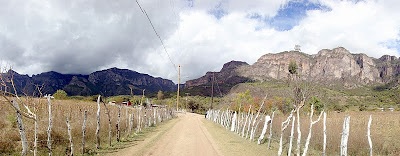
We didn’t see any runners but, apparently, Creel with its hotels and El Chepe (the train) is a tourist town. The true Raramuri lived in places no roads penetrated. According to Caballo Blanco the highland Raramuri were training hard to unseat those from the deep canyon, who’d been made somewhat famous by the book and had more-or-less dominated the race. While some of us had race ambitions we were mainly there to experience the rivalry first hand, and all else that goes with it.

Unfortunately, while nothing bad happens to me in Mexico it doesn’t mean they don’t happen elsewhere. Back at home Romney was dealing with Tuco not moving, eating, or drinking. The vet wasn’t sure if he’d had a stroke or not but the day I left he’d been hiking and running like normal and now he couldn’t get up and refused to eat or drink. Since he’s very old this was inevitable but his rapid deterioration took us by surprise. There was nothing I could do but he was breathing well and wasn’t going very quickly. If he wanted to die being “the fittest animal on the planet” most of his life wasn’t doing him any favors.

Bob, who provides Tuc’s summer home, flew out to see him. I decided that if he improved at all I’d come home, too. The first note I got wasn’t too encouraging. “I think he’s over it,” it read. But a short while later he drank, and soon after that he ate some bacon, by which time I’d already plotted a course to get back. The race will be here next year. Tuc probably won’t. And even though, as my friend Binky put it, “he left it all on the floor,” I felt I should say good-bye.

Traveling out of the Copper Canyons is not simple. I tried to catch El Chepe but missed the final train of the day. Two bus rides, a taxi, and three flights later (that included a 40 minutes transfer where I had to clear customs and run across LAX through three terminals, at least putting all this race training to some use) and 25 hours later I was back with my buddy.

Postscript: Though he couldn’t get up when I got here Tuc’s been doing better each day. At first he was so uncomfortable he could only sleep a couple of hours at a time (meaning so could I), but now he’s getting up on his own and sleeping through the night. Yesterday he even ran about 50 meters. The big adios is currently on the back burner.

More than 50 gringos made the trip south, a record by far, to compete with hundreds of Raramuri. The highland Raramuri dominated the race, getting 7 of the top 10 spots. "They could compete with anyone, anywhere" - CB. Juan Quimare, relative of Arnulfo who was made famous in the book, was the top deep canyon finisher in 4th. Nick was the highest placed gringo, coming in 6th. By all accounts it was an amazing experience for everyone.


pics: thanks to brooke cantor for the pics of the canyons and the race. the other shots are our crew in creel. you can see more pics and read more about the raramuri and the canyons at his web site, http://www.norawas.org/

Tuesday, March 09, 2010

Indoor vs Outdoor Training


“A real man likes the feeling of nature against his face.”
- Wang

“And a wise man has the sense to get out of the rain.”

- Egg Shen

Not my favorite author Gina Kolata has penned another not so interesting article for the New York Times. Unlike some of her other work, however, I won’t call this one bad journalism. It’s actually reasonable research. It’s just not complete. I’m also just not sure who doesn’t already know the answers as to which is more effective, indoor or outdoor training for outdoor sports.

As she states:

The most obvious difference with indoor exercise is a lack of wind resistance, Dr. Cavanagh said.

“The important variable here is speed relative to the air,” he said. For example, if you are running at 8 miles per hour into a 10-m.p.h. headwind, your speed relative to the air is 18 m.p.h. Dr. Cavanagh explained in an e-mail message: “Work done against air resistance can be extremely costly because the ‘drag force’ (force caused by air resistance) is proportional to the square of speed and the power required to overcome drag force is proportional to the cube of speed.”


Hmm, yes. Obvious. It then moves into not-so-much-more shocking,

“If you run all the time on a smooth surface you are not training all muscles in your legs and feet that you need to run on the road,” Dr. Cavanagh said. “If you are going to race under certain conditions, you might as well train there.”

The article proceeds with further testimonials from experts as why it’s better to run, ride, or row outdoors While for me this should be preaching to the choir I can’t help nitpick the lack of objectivity. As usual, Kolata misses out in addressing the benefits of indoor training (to be fair she does state it’s safer). But the real advantages are that you can isolate systems from outside influence where great performance gains can be made. You then need to integrate these gains back into the sport of choice but it is an advantage you have when choosing to train indoors.

Okay, so none of this is groundbreaking info. So why is it here? Mainly as an excuse to show this friggin’ cool mtn biking video. When someone can figure out how I can do this stuff inside of my house I might actually considering not going outside so much.

Saturday, March 06, 2010

Taking Back Our Lives

I don’t generally re-post but I was doing some research for an article and came across this old rant that seems as relevant now as ever.

The Fattening Of America

Back then my blog had fewer readers and, frankly, less focus as I was testing the waters as to what type of information it should contain. So my guess is that a lot of my current readership hasn’t seen it. It’s, essentially, akin to the film Fresh in that it’s about getting proactive and doing something about our personal situation when it comes to our health. Some topics never seem to age, though it’d be nice if this one did. Here is the closing:

All this apathy towards things that really matter allows our corporations to have their way with us. We’ll work longer hours, for less money, with no health care, and no vacation plan, for little retirement, just so long as the Yankees can win another pennant. During the time Roger Clemens has been pitching, we’ve seen the discrepancy between rich on poor in our country widen to the point that we’re, statistically, a third world nation. Our minimum wage has only raised a fraction and is current half of all other first world countries. Our president told a woman who spoke of working three jobs in order to just feed her kids that her situation was “uniquely American”. We’re grown too tired, too busy, too broke, too distracted to even bother with the basic things that we know keep us healthy. When did this happen? It’s not the America I grew up in.

But the real problem isn’t George Bush, the media, or the Enron’s of the world. The problem is us. As a society, we just don’t care enough anymore about what really matters. We need to wake up and take back our lives.


And, literally, that’s all it will take. Sure, the corporate stranglehold and statistical disadvantages won’t change over night. But your health will. And no matter how broke or busy we are become no can still eat better food and find thirty minutes a day to exercise. It’s really as simple as watching less baseball.

Friday, March 05, 2010

Fresh


Fresh is in my mind the best of all the recent food movies. If we could make this film required viewing in our schools it would change the world, and along the way take the biggest single bite out of our obesity epidemic of any movement so far. The reason is that instead of dwelling on the problems that mass food production is causing, it focuses on the solution. And the cool thing is that it’s a lot easier than most of us think.

The problem with all the Fright Club style films is that they make us think the problem of the world are too vast to do anything about. Sure, they get you mad. Maybe they even inspire you to activism. But that’s a tough road to hoe for most of us. Fresh addresses the problems but its focus is on the solution, using examples of the individuals that are doing something about it and how effective they are.

Here are some hopefully statistics:

- One farmer makes a living on 3 intercity acres in Milwaukee.

- Another, on a small spread in Virginia, practices holistic ranching by moving his animals around the farm to complete a natural cycle so he doesn’t need to use any fertilizers or pesticides or even plant crops. He gets the highest yield possible out of his acreage, which stays exceedingly healthy, and brings in $3,000 per acre, compared to the $150 per acre that our subsidized industrial farms yield.

- Another quit using the “recommended” pesticides and antibiotics and now saves $14,000 dollars per year and has healthier animals.

- Food from mass production farms and ranches yields 40% less nutrients, which has been reflected on the labels and, for some reason, isn’t causing a national outcry (this is the obesity epidemic by itself, as well as adding to other aspects of our health care load. It’s not tricky math. If you need to consume 40% more calories to get 100% of your needed nutrients there is no other possibility than becoming obese.)


The film brings to light the fact that food production isn’t the complicated quagmire we're led to believe. We can all produce food in our own homes. Local co-op farms can feed entire communities. In exactly the same manner that we can turn our homes into generating plants that can meet our energy needs, we can grow food locally that meets our nutritional needs. And the result will not only mean a healthier world but a more economically sound one. The stats are unequivocally one sided. We can feed ourselves better than any big corporation.

There’s a line in the film where someone says “the only thing Americans fear is inconvenience.” To change this we don’t need revolution. We don’t need any great leaders. And we certainly don’t need a bunch of corporations telling us what to do. All we need is some very simple grass roots education and we’ll do it ourselves.

To start, bookmark the Fresh site and sign up for their newsletter.

The film is only available for screenings. Though you can purchase a private screening it would be more fun to attend a public one. If it's not playing in your community you can organize a screening yourself, which they will help you organize. Go here for details.

Monday, March 01, 2010

Analyzing Dairy Claims

It's high time to again pimp The Real Fitness Nerd, one of the publications where I occasionally scribe. The credit goes to Denis Faye in this instance for his straight dope attack on dairy claims.

Having a cow over cheesy dairy claims

Instead of summarizing I'm going to suggest you go and read it. If you like, subscribe to the Nerd as your critical eye to what's happening in the fitness and nutrition world.

I've cast doubt on the dairy industry's integrity myself (search my articles and mailbag). This inevitably motivates an attack from the uninformed masses that are led to believe that humans can't exist without dairy. No exception here, where one reader tries to defend the industry's claim that milk is an important source of vitamin D. Nice to see Denis ferret out the bullshit.

Sunday, February 28, 2010

Some Fun P90X & Insanity News

Certainly the Barrancas del Cobre will offer some good blogging opportunities but, while you wait, Ben Kallen over at the Beachbody office found some fun news on Insanity and the X. Enjoy!

According to Atlanta Journal-Constitution sportswriter David O’Brien, the Braves’ Matt Diaz did P90X again during the offseason this winter:

Diaz doesn’t call around to ask reporters or club personnel: “What about me? Will there be a roster spot or any playing time left for me?” No, he hangs out with his family in Central Florida while all this is going on during the offseason, does his P90X diet/fitness regime for the second winter in a row, and prepares for spring training and the 2010 season.

http://blogs.ajc.com/atlanta-braves-blog/2010/02/25/diaz-mr-amiable-ready-for-whatever-role/

The Washington Redskins’ blog links to a year-old YouTube video in which quarterback Colt Brennan filmed the team’s training staff doing P90X:

http://blog.redskins.com/2010/02/16/redskins-name-larry-hess-head-athletic-trainer/

This weight-loss blogger is doing Insanity while wearing a GoWearFit electronic activity tracker, and posting the results. On Day 2, you can see that she was burning up to 14 calories per minute.

http://www.myallnaturalweightloss.com/insanity-workout-review-day-two/1091/

Friday, February 26, 2010

Copper Canyon Ultra Marathon


Right now I'm packing to head south and join Caballo Blanco and the Raramuri in the Barrancas de Cobre. This video explains the event pretty well. Enjoy.

Monday, February 22, 2010

Customizing P90X


Anyone who follows my blog has read a lot about how to customize P90X for sports, specifically the ones I do. Now I’ve writing a series about how to customize the X for all sports (including mass, weight loss, and combing X with other programs--like Insanity--which aren’t sports but could be objectives for sports) and, finally, we’ve got the archive up. Here it is:

The P90X Newsletter

I think that in order to get both the Beachbody Newsletter and the P90X newsletter you need to enter different email addresses. The may have fixed this but if you aren’t getting both try that. Beachbody coaches feel free to share this info so I can quit answering email about it!

The normal Beachbody Newsletter (why not get both, they’re free?)

To read the customizing series, begin with newsletter 4 on defining muscle confusion, then skip to customizing X and read forward in order as each article in the series references the older ones. Each article is short but there’s a lot of physiological info to understand (keep in mind it’s written very much for the layman) if you want to create your own training programs, which you should. The series is far from finished. Next up are running and triathlon training.

* There is no place on the X archive page to sign up, but you can sign up for both on the main BB archive page.
pic: back in the day: one of our first brainstorming sessions about 90x.

Friday, February 19, 2010

Is Cleansing Real Weight Loss?


I just did a three day cleanse and lost 10 pounds. By the new American standard I’m hardly fat, so how can this happen? And since it did, is it real weight loss?

I’m currently working on substantiating the science behind P90X so it can air in the UK. Not only is their science criteria more stringent than in the US, they also won’t accept our testimonials who have lost more than two pounds per week because they’ve deemed this unsafe. As the guy who always champions stricter controls about what can be claimed on food and supplement packaging, it’s funny to stand up cry at a regulatory agency that we’re the ones getting hosed.

Two pounds per week is a perfectly acceptable outside limit for body composition change. I would even argue that it’s unlikely you could sustain this for very long. But over the course of a short-term exercise program, especially one that’s combined with diet, you can lose far in excess of this. It happens in our test groups all the time. The reason is the cleansing effect you get, which is real. It’s a one-time effect but we should not discount its importance.

Since I’m the de facto Raton Blanco (white mouse) around here let’s use my week on the Shakeology cleanse as an example:
As noted in the other post, I began my cleanse after a weekend of debauchery. Sure, I ran a ton but I also ate a lot of bad food and drank a lot of beer. Since I’m not used to eating and drinking that much my body was hanging onto a lot of excess food and my cells retaining too much water (also because of the long runs in a drier climate causing an emergency storage response). The flushing effects of the cleanse got rid of this and brought my body back into homeostasis. But now I’m lighter than I was prior to the weekend, and that is true weight loss.

It’s worth noting that my cleanse would be considered high calorie compared to most. I was probably eating 1500 calories a day. I was just eating nutrient dense foods with a lot of fiber (low density food with high density nutrients). Essentially, it was just good clean eating with a lot of water and no junk—the same thing our test groups do. I feel great and everything is again running properly.

Many people rarely feel this state of being. If fact, they walk around most of the time in my pre-cleanse state. It’s sad when you think about it, but if you rarely exercise, eat bad food, poison yourself daily with drugs (legal or otherwise—soda, a drug when you consider what it’s made of, makes up more calories world wide than any food) you won’t even know what feeling good means. Unfortunately, the average US citizen likely never functions properly.

When we begin a good diet and exercise regimen we will always flush undigested gunk out of our system and bring our hydration levels into homeostasis (most people retain way too much water due to excessive sodium in our diets). Then we lose weight. And if it’s weight that you’re always carrying around with you, it has to be considered real weight. No matter what those Limeys say.

pic: earning my cleanse at milt's, one of the west's best diners.

Wednesday, February 17, 2010

Never Say Never


When Romney got wind of my 07 birthday challenge she had absolutely no desire to participate. A year later, as my wife, she felt an obligation to support what I called an off year challenge. During the latter stretch of my 17 hour affair she said, “I wasn’t sure about these. I kind of thought I might want to do one. But I’m exhausted and all I’ve done is belay. Now I know, for sure, that I’m never doing a birthday challenge.”

Last Saturday she proved herself a liar. Not only had she done a birthday challenge but she’d done an absurd one; an “ultra” marathon. Until a few months ago, not only had she no interest in punishing herself on her birthday, she “didn’t run.” So I was probably as surprised as anyone when out of the blue she targeted the Red Hot Ultra as her objective.

In the five weeks she trained for the event I kept hearing complaints. I tried to tell her she didn’t have to do it (I think challenges are/should be fun) but she wouldn’t hear of it.

"... they don’t call it “The Birthday Pretty-Hard," she’d mutter each time.

Her blog examined her trepidation:

There are days when I’m sitting around and think I’ll just get in the zone and run for however long it takes. Then there are days when I’m running and I think, “this is going to be impossible.”

This lasted up until the morning of the race. At check-in she said, “what am I doing here with these people?” But not only did she finish an hour and a half under her expected time, she finished with a smile. And even when she was suffering she copped to having a good time. This certainly must have been the case. As the weekend progressed her enthusiasm increased until she started saying things like, “I wonder what a hundred would be like?”

As usual, my talented wife explains things better than I do. Congrats, baby!

Birthday Challenged


pics: bounding through the snow during the race; under castleton tower thinking about what's next

Power & Aging II: Darrell Green

Tuesday, February 16, 2010

Shakeology Cleanse


Here’s a little inside information for the Straight Dope faithful. It’s a three day cleanse (I’m doing this week) that’s becoming a standard part of our diet guides. It came from Mike Karpenko (Beachbody coach who once worked for me in the office and still runs our test groups with me) as an evolution of a cleanse I’d done using Shakeology as a substitute for our current fasting formula. Mike spruced it up a bit, we turned it loose on our test groups, and voila!

I’ve just returned from a weekend in Moab for Romney’s birthday (and birthday challenge, report coming soon). Along with a fair amount of exercise we did a fair amount of reveling. I mean, it’s the off-season and pints are two bucks around town and what else are you going to do on a birthday weekend? Therefore, even though I spent four to six hours each day running around I feel like pig that’s been fattened for slaughter, making this a perfect time to flush my system and bring everything back into homeostasis.

This is a performance-oriented system designed to support hard training. It’s not the Master Cleanse. The goal is to promote flushing junk from your system and regulating hydration levels. It’s calorically restricted to be sure. But in its 1500 or so calories will be more nutrients than most people get by eating well over twice that amount. The key is caloric efficiency; getting the most nutrients possible out of the fewest number of calories.

It’s too fat restrictive for a lifestyle plan. I’m on a low cal cycle of the ABCDE diet so it’s the kick start to that. After three days I’ll roll this into a 1600 calorie a day plan with additional calories added for sports performance only—this means targeted calories consumed during and immediately after workouts don’t count in the daily total.
The plan consists of three Shakeology shakes* a day with a salad in the evening. If the shakes are plain (Shakeology and water only) I can add three pieces of fruit. The salad is unrestricted as far as veggies go, with 4 ounces of a protein source (if it’s meat or fish and slightly more if it’s a veggie source like legumes), and two tablespoons of an olive oil/vinegar dressing. For fatty acids, each salad will also contain a tablespoon of chia seeds (or flaxseed or hempseed). Plenty of water washes it all down. Coffee, tea, and herb teas are fine as long as they are sans additives, as all are performance enhancing. In three days I plan feel recovered from the weekend and ready to roll into my final prep phase for the Copper Canyons.

* Any meal replacement or protein shake could be substituted but I’d recommend adding at least a greens formulation to this to try and equate Shakeology’s 70 ingredients.

pics: romney's run looking less than the promised "red hot" conditions, rare postholing conditions on castleton, celebrating romney's "never say never" birthday challenge.

Friday, February 12, 2010

And You Thought Your Ride Was Epic


It was like I had entered some alternate reality hell. I could barely see, the wind was screaming so that I might as well have been riding on the runway at LAX, the rain really hurt and made navigating extremely difficult, I was freezing now, and my brakes were giving up the battle.

Riding. In the mountains. In a 50 year storm. Through a gauntlet of boulders being cut loose by a combination of fire followed by rain. Sound fun? For your weekend entertainment here’s a tale of an epic ride from my friend Aaron.

A Ride Worse

I’ve ridden this loop many times. And I’ve ridden it in the rain. But I haven’t seen it during a 50 year storm. And certainly not after the worst fire season in the history of the area, where the rain turned one of the most beautiful mountain passes in the USA into a road cyclists’ version of the North Face of the Eiger.

It wasn’t until I’d made it about a mile down that I realized I was a true idiot and had made a terrible mistake. As I was navigating through a relatively entertaining mine field of baby head sized sharp rocks on the road, I heard a crash from 40-50 feet up and saw a boulder smashing down the hillside on a collision course. No Fucking Way. People do NOT get killed by boulders while road riding! I grabbed what brake I had in the wet and swerved...

It’s posted in a more apropos home, on the Ritte Van Vlaanderen cycling site. This is my new team, which you'll certainly hear more about as the season kicks in. Started by my friend and fellow birthday challenger Spencer, it’s pretty much the embodiment of why I ride and sometimes race. To train hard, to have fun, to mix it up at the races, do epic rides, look cool,look really cool, but never take yourself too seriously.

pics: aaron's favorite doper, the lion of flanders, and the ritte boys doping retro.

Tuesday, February 09, 2010

Let Moderation Be For Other People


I’ve always thought the cliché everything in moderation was ridiculous. Now I’ve got some stats to back me up. The “world’s largest study on running” has concluded that more exercise is better, period.

“The government was saying you get benefits by walking three or four times per week. My data has shown that the more you do the greater the benefits,” stated Lawrence Berkeley National Laboratory scientist Paul Williams to the San Francisco Chronicle. “I’ve had people doing 100 miles a week of running and you could see benefits up to that level.

Williams has studied approximately 100,000 people over the last 20 years. He reports that exercise seems to prevent heart disease and stroke, as well as vision problems, like glaucoma and cataracts. He speculates that a link between running and cancer prevention “may just be a matter of time” since most of his subjects were young when the study began. The study doesn’t just observe running. “Any sort of regular aerobic activity helps,” say Williams. “The more hours they put in, the more benefits they’ll see.”

So where did all this moderation nonsense come from? I can understand recommending vices in moderation. This makes sense. A bevy of studies indicate some amount of “bad” behavior can be healthy. So, yes, by all means moderate those things that we know can cause harm. You know, smoking, gambling, watching TV, impromptu drag races on public roads… things like that. But healthy stuff? Why should we moderate our eating habits, getting enough sleep so that we feel good, challenging our brains to learn new things, and exercising? To paraphrase my favorite doctor (Bones per the Captain), where’s the logic, man?

According to the article, “doctors and public health officials worry that with half the country not meeting the (current) guidelines, even talking about running 50 miles per week will intimidate folks who aren’t doing anything.”

This is bullshit. It’s a smokescreen. If more is better, and we know it, then the common sentiment should be that more is better. This, of course, doesn’t mean that you can’t advise easing into exercise. Doctors are supposed to advise things. But we do the opposite. We—as a society--caution away from too much exercise. That we’re of lawsuits or worried that recommending too much exercise might lead to injuries doesn’t make sense when you consider that it’s a 100% fact that too little exercise leads to illness and pre-mature death. So what gives?

Call it a conspiracy if you want, but how are doctors going to stay in business if nobody gets sick? How are corporations going to keep their salaried employees working 16 days if the public conscience is that they should spend a few hours a day moving around? How are marketers going to sell ad space if we stop spending five and a half hours each day surfing the net and watching TV*? Where’s all this moderation talk when we really need it?

My dog is 15 years old. He’s outlived the expected age for his breed by 40%. Most “responsible” (their word) dog owners and vets have told me I work him too hard. He’s climbed hundreds of mountains. He’s run multiple marathons. He’s done ultra marathons. Somehow, all this exercise hasn’t killed him but made him stronger. In fact, he still gets out for two miles or so a day and is grouchy when he doesn’t. Sure, he’ll die one day. We all will. But his life, which has been anything but moderate, is testament to my belief that life should be lived full on, and that everything in moderation is a societal excuse to give up your life it live it as defined by others.

* Based on a study that’s a few years old. It’s probably worse now.

pic: tuco at 15. still running.

Monday, February 08, 2010

Nordwand


Finally it appears as though we're getting a climbing movie in the narrative genre that's going to be seriously good, as opposed to unintentional comedy (not that there's anything wrong with that). This film, in fact, looks amazing. For the time being it's only in limited release so check the dates on this page and see it. Generally the numbers during screening runs determine whether or not a film will get a larger release.

For those who aren't familiar with the story of Kurz and Hinterstoisser I'm giving away nothing. But one of the most vivid memories I've held on to comes from reading the account of this climb, years before I was an actual climber (meaning a long long time ago). If you're interested in the history of the Eiger, read The White Spider, Eiger: Wall of Death, or just watch The Eiger Sanction and call yourself educated.

I'm more attached to this mountain than most. Its lore was a catalyst for me to start climbing. I've done an Eiger Sanction themed birthday challenge. And I was married under it. One of these years I'll have to take my turn in the barrel. Ben says that at 35, give or take, I'm a little too old for the Eiger. But as I've always said: good weather, bad weather; now or later; any time is good for climbing.

Thursday, February 04, 2010

Sore, Hungry, & Slow


There are a few indicators that let me know a training program is working. The big three are getting sore, getting hungry, and then getting slow. You can’t avoid this scenario if you are incurring any kind of serious body composition change. In this article I explain the process in some depth.

Sore, Hungry, and Slow: 3 Signs That Show Your Program Is Working

I wrote it a few weeks ago, back in my hypertrophy phase, but I couldn’t post it then because the newsletter I wrote it for is new and the archive page wasn’t set up yet. It’s an important piece of information because too many people back off their training instead of pushing through and allowing their body to adapt. There are times when you shouldn’t push through pain but there are times when it’s essential.

I’m still getting sore adapting to longer and longer runs but my climbing training is in power mode, where soreness means injury. During power training you should finish your workout feeling as though you didn’t do much. Slowness, too, has vanished. When your muscles are growing during the hypertrophy phase you get slow. Power is training these new muscles to get strong, or fast. You should get faster and faster as you train power, and never be sore.

You can be hungry in any training cycle but it’s also a part of the hypertrophy stage. Your muscles are hungry because they are growing. I was very sensitive to the changes in the ABCDE diet during hypertrophy. All three symptoms would increase during my low calorie phases, almost instantly; an indicator that training is on the rivet, where it should be.

pic: an obvious indication of a family in hypertrophy phase.

Tuesday, February 02, 2010

One Louder


Power training is a delicate balance between rational and irrational. Yesterday’s harebrained scheme pushed it too far but, hopefully, not so far as to interfere with my program. As Nigel wrote on my Facebook last night, “it’s such a fine line between stupid and clever.”

I mentioned the dangers of power training the other day. Whenever I’m at my limit I’m always trying to gauge whether or not it’s too much and attempting to back off before I hit the inevitable “one move too many”. Until Sunday, each successive workout was building on the prior workout fairly substantially. But my program isn’t for one sport. It’s a hybrid with the aim of concurrently building different energy system fitness for different sports at the same time. Friday I’d done a hard 2.5 hours of running on the trails. Saturday Romney and I did an easy six. Easy, but still six hours on uneven snow with probably 4,000’ of elevation gain. Sunday I was a little tired.

In all training for climbing I used to have a rule that if I warmed up and didn’t feel right I bagged the workout. (I still have it, though I haven’t seriously trained for climbing in ages so used to seemed more appropriate). So after 30 minutes or so of easy climbing I stopped.

Yesterday I completed my warm-up. I wasn’t feeling strong but proceeded anyway because I felt fine, just not strong. I’ve been upped the resistance I use on the simulation I’ve set of my project each workout. Day one it was everything I could do to just do the moves, and then complete the three individual sections. Subsequent workouts added weight (using a vest) until I could hike each move first today. Today the plan was to add ankle weights.

Then I got a bright idea (these inevitably go wrong). Instead of using my small ankle weights on my ankles I opted for the larger ones and put the small weights on my wrist. I did a few easy moves on big holds and then cranked up Big Bottom and went for my project.

And wrong it went. I tweaked a finger. Not bad, but definitely a tweak. Feeling that it might be minor enough to finish the workout as long as I stopped climbing I rested and then began my hangboard session. It lasted two sets or so before I became certain it was at least some kind of injury and was off to ice. This morning it feels good. Almost 100%, but still, almost. Time will tell. Certainly shutting the workout down was the right choice .Whether I stopped early enough remains to be seen. If I did I’ve dodged a shit sandwich.

The crazy thing, really, is that can’t stop thinking about whether I can do the moves weighted down as I was. I think that I can, in fact, if my joints remain intact. And that is the crazy drug of power training. Our bodies only go to 10. We’re always trying to push them to 11.

video:ben's i-phone captures an attempt on the delicate slab climb, 'lick my love pump.'