Wednesday, June 20, 2012

No Meat? No Problem.


In the wake of last week’s post on vegan boxing champion Timothy Bradley comes an article from the NY Times asking the question Can Athletes Perform Well On A Vegan Diet? While the champ offers an anecdotal yes there are further considerations, which is where Gretchen Reynolds’ piece begins by questioning three nutrition experts about what might be missing should one go meatless. This, of course, begins with protein.

You do have to be diligent about protein intake if you’re vegan. I have clients, especially women, who say, ‘Oh, I put a few chickpeas in my salad.’ But that’s not going to do it. Women need about 60 to 90 grams of protein a day, and athletes are on the high end of that. That means you have to eat cupfuls of chickpeas. And you can’t eat a quarter of that cake of tofu. You need to eat the whole thing. It’s not that there aren’t good sources of vegan protein. But it’s not as bioavailable as meat. So you need to have more.

Most of you are already aware of the protein issue but other things, such as B12 weight loss, and creatine are also evaluated. It’s a quick read, and not all that earth shattering, but weighs the issue with a healthy dose of common sense.

I like to tell people that if we got most Americans to eat one less serving of meat every day, there would be far greater impact from that, in terms of improving overall public health and the health of the planet, than convincing a tiny group of endurance athletes to go full vegan.

And while the article focused on endurance parameters only, leaving Bradley alone as the torch bearer for power athletes, all experts agree that it’s possible to get all of your nutritional needs without meat and dairy, something that heavily-lobbied USDA isn’t ready to admit yet.

Saturday, June 16, 2012

The Best Article Ever About...

...basketball, although it can be applied to anything. If you’ve been watching the NBA finals, which you probably haven’t if you read my blog, you’ll notice one conspicuous name amongst those you’d expect to star in each game: Shane Battier. He was the subject of an article written a few years back by Michael Lewis (author of Moneyball) that was called by many people I know one of the best articles they’ve ever read, which includes praise from people who hate the game of basketball. It’s a fascinating take on the game, and life in general, and is getting dusted off because of Battier’s play in the finals, where he’s actually been getting mvp consideration in reader poles so far.

The article is titled The No Stats All-Star and is more a homage to intelligence than anything else. Battier views the game differently than almost anyone. And even though he rarely does much that makes highlight reels his teams almost always win. It’s fascinating. So much so that to me, someone’s who has been around the game my entire life, it’s more exciting than highlights like this.


Battier’s game is a weird combination of obvious weaknesses and nearly invisible strengths. When he is on the court, his teammates get better, often a lot better, and his opponents get worse — often a lot worse. He may not grab huge numbers of rebounds, but he has an uncanny ability to improve his teammates’ rebounding. He doesn’t shoot much, but when he does, he takes only the most efficient shots. He also has a knack for getting the ball to teammates who are in a position to do the same, and he commits few turnovers. On defense, although he routinely guards the N.B.A.’s most prolific scorers, he significantly ¬reduces their shooting percentages. At the same time he somehow improves the defensive efficiency of his teammates — probably, Morey surmises, by helping them out in all sorts of subtle ways. “I call him Lego,” Morey says. “When he’s on the court, all the pieces start to fit together. And everything that leads to winning that you can get to through intellect instead of innate ability, Shane excels in. I’ll bet he’s in the hundredth percentile of every category.”

In this typical Battier highlight, he appears to get schooled by Durant. A lesser player, however, would have also fouled, which would likely result in giving up 3 points instead of two and also stopped the game clock with Miami leading and time winding down. It’s one of the invisible strengths Lewis is talking about.


It’s a fairly long read but certainly worth your time. Psyche isn’t all about frenetic, hard driving action. There’s plenty to be inspired about keeping ones wits about them, especially under pressure.

Friday, June 15, 2012

See You At Beachbody Summit!


I’ll be doing two presentations at the Beachbody Summit next week. If you’re around on Thursday, stop by the Core area at either 12 or 5 to catch the act. These two sessions will preemptively answer a lot of questions about our products and, basically, help you become a more efficient coach.

I’ll also be at the usual venues, parties, etc, as well as Certification the two days prior to Summit’s official start. You can catch me anytime for a chat but, given there will be more than 5,000 of you this year, that’s going to be more problematic than in years past. So come by Core on Thursday or, better yet, come early and get P90X Certified and I’ll load you up with information that will take your coaching to a higher level.

Here is some information on my two presentations. Click on the highlights for more:

How to put your customers in the right exercise program.

I can state how much easier this will make your job. With the right program you’ll get results as easily as A, B, C. With the wrong one you can struggle and get frustrated and spend a lot of time looking for answers. Choosing the right program is step 1 in getting the best results.

How to recommend the right supplements for the right program.

Supplementation are a key part of your tool kit for results. They aren’t magic but can seem like it when used correctly. Every supplement has a purpose and understanding what it is and how it fits with a customer’s goals is a key part of finding success. I'll also be going over some of our newer supplements, like E & E and the new line designed for Beast, which can be utilized elsewhere to help maximize your training.

Efficient coaching.

Learning where all of Beachbody’s resources to help you educate and motivate your customers are located and how to use them will not only ensure your customers reach their goals but save you valuable time.

Finally, consider getting certified. The more you know about the science behind the creation of an exercise program, the more effective you'll be at teaching it. This is particularly true for P90X , which is both versatile and complex, and can be utilized and structured various ways based on the needs of the individual client. You’re coming to town anyway, so why not add this to your coaching arsenal?

See you next week!

pic: summit's always rife with photo ops but this pic, from a coach trip in france, is posted for another reason. i'll have both road and mtn bikes in tow and need to train so hit me up if dawn patrol intervals sound fun. i'll go climbing at least once during the week, too, if you want to pack yer boots.

Wednesday, June 13, 2012

3 Weeks Of Hell


Training sucks,” said my friend/mechanic/bike shop owner/climber/drinkin’ buddy Tyson the other day as I was dreading heading out for my first interval session on the bike this year. “Riding bikes is great,” he continued. “But training is terrible.”

It’s only three weeks,” I countered. “That’s what it always takes to transition to a base of fitness where it’s no longer miserable. But it’s three weeks of hell.

I’ve been putting off writing this blog—perhaps dreading is a better word—because once it’s published I have to do it. And while I’m often so excited about training that I can barely keep from overtraining out of the gate this is not one of those times. I can’t seem to change my mindset and am not sure exactly why. Maybe I’m more psyched on climbing. Maybe exploring trails sounds more fun than repeated intervals. Maybe I’m just old. But for whatever reason I’m looking forward to the Butte race with about as much enthusiasm as a colonoscopy.

But I stated last week that I’d write up an example so here it is. Besides, I’ve been doing it anyway. And while it hasn’t been pretty, and every morning I wake up feeling as though I was in a bar fight even though I’m ramping up intensity very slowly, I will sally forth and record the results for posterity. ‘Cause that’s my job and, to be honest, I love it even when I hate it because in the big picture it’s another experience to reflect on and learn from.

So here ya go; a glimpse at race build-up from 7-weeks out (while concurrently training for climbing). To understand the reasoning you need to read the backstory here:

The 5 Most Important Factors of Race Training

Week 1 (went like this)

Day 1 – Long mtb ride: a little over 3 hrs of saddle time and a few thousand feet of climbing. Felt hard, especially after 2 hrs. Long road ahead. Did easy yoga and a little foam rolling.

Day 2 – 4 X 10 min intervals full-on with 5-7 min rest in between. Did hill repeats on mtb. Felt weak, miserable. Still sucked it up for some NIS stretching and a 20 minute core workout afterward.

Day 3 – 45 min aerobic spin on the fixie and easy yoga. Went climbing all day.

Day 4
– Biking rest. Climbed half a day. Did easy yoga.

Day 5 – Easy 1 hour mtb ride on trails. About 1,000’ of climbing done easily spinning. No hard efforts. Nice ride. Slacked on post-ride stretching.

Day 6 – 2 X 20 minute full-on intervals. 15 min rest in between. Two long hill repeats. Felt horrible and slow but could feel a slight power improvement from previous workout. Abridged stretching session. Easy recovery climbing in the PM. Blew off both foam rolling and planned full body workout session. Dumb but seriously lacking motivation.

Day 7 – 1 hr RUKE (run/hike), no bike. Hard climbing/training session. Asylum Strength. NIS stretching and foam rolling. This is today. Enthusiasm is a bit higher writing it, probably thanks to reading an old Ben Moon training dairy this morning. Remains to be seen how it goes.

Evaluation from week 1. It happened and that’s a start. Need to get much better at restorative stuff: foam rolling/yoga/core/stability work. Hopefully psyche will perk up.

Going forward this is my template. Each week to consist of:

2 hard targeted bike workouts, always some type of intervals. Goal is to slowly increase these to 4 X 15 min and 2 X 30 minute of all out climbing. These workouts are highly stressful and require a lot of recovery so my daily recovery modalities, supplementation, and diet need to improve.

1 long ride. Saddle time is sorely lacking. Bonked after hour 3 on first ride. I need to be able to do 8 hours without a thought because that's probably where Butte really gets started.

2 recovery rides. Hopefully these are nice trail rides. Lots of spinning and work on technique.

Daily mobility work – either foam rolling or yoga, hopefully both. All of my down time (TV, movies, post-ride beer, etc) should be utilized to work on this weakness. Week 1 was not nearly good enough.

Core and stability work – done post climbing workouts, 2 X per week.

Full body training – One Asylum/P90X2-type workout each week to stay sharp. One hard resistance/agility/plyometric workout during the week helps hormonal production stay high provided recovery is going okay, so this is evaluated on the fly.

Climbing – 3 sessions per week, 2 of them hard. Either outside or in the Coop. Currently climbing outside a fair amount but might move towards hangboard training as bike volume gets high because it takes less total energy output—plus is better training than climbing anyway.

2 weeks away from the race I’ll do a big test, then taper towards race day. The general pattern is 3 weeks of hell followed by a shift in mindset and inspired training. But we’re not machines and things always go a little different, and that’s where all this training stuff gets interesting. I’ll report back after Butte with the results.

Monday, June 11, 2012

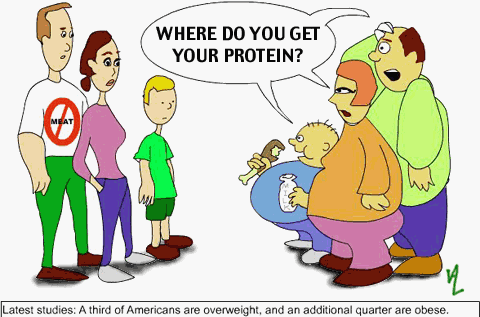
The Vegan Champion


Congratulations to Timothy Bradley for his victory over boxing legend Manny Pacquiao this weekend, making him the undisputed vegan world champion. While there are a number of celebrated endurance vegan athletes, notable vegan power athletes (like Mike Tyson and Carl Lewis) have up-until-now been retired. Power sports have long been a carnivore’s domain but there’s a new sheriff in town and, with him, a modern template for addressing performance nutrition.

“Dude, I swear it’s the most unbelievable feeling ever,” Bradley said, praising the diet he believes would give him a definite advantage in the ring.

“The reason I love it so much is I feel connected to the world. My thoughts are clearer, crisp. I am sharp. Everything is working perfectly. I feel clean. It’s a weird feeling, man, it’s just a weird feeling.”


Bradley was already a champion but moving up in weight and beating Pacquiao will make him a household name. He isn’t a full-time vegan but that shouldn’t discourage his testament to nutrition because he gets strict when he’s training for a fight, which is where most vegan detractors stake the foundations of their rationale; at the pinnacle of performance. In fact training is exactly where our diet should be tested because what works for the highest-levels of performance is the template we want to use as a base. In the below video he talks about where he gets protein, stating “I don’t really take that much protein,” busting a popular notion of what it takes to be ripped. In the great HBO 24/7 (top video) series he talks about having stores of excess energy, so much that he doesn’t need much sleep even though he’s training 5 or 6 hours per day.

bradley talking about getting protein as a vegan

The main knock on veganism and power sports has always been that you need animal proteins for absolute strength. And while it might be true that the amino acid profiles of meat make this easier to get the proper amino acid ratios the science isn't valid because you can do it without meat and dairy. All that’s been lacking for the public has been a real life role model.

If you’ve followed Beahbody’s diet plans you know we tend to begin with high protein (or low carbs) and graduate towards much less protein/more carbs as you get fitter. This is more as a personal training tool than anything else (though not totally as restricting carbs on an exercise program teaches your body to metabolize fat as fuel more efficiently) because most people eat too many bad carbs and once you learn the relationship with carbs and energy in your diet how to eat becomes much easier. The fact is that your body does not utilize protein very efficiently and beyond a certain amount you’re not utilizing it as protein anyway. It’s vital, and you absolutely need it all day long, but healthy vegans eat mainly whole foods and the beauty of nature is that in their natural state most foods have a solid balance of proteins, fats, and carbs. The more your diet is based on whole foods the less you need to worry about macronutrients because nature will do that for you. A whole food vegan would likely have little need for our basic plans, which is why you currently only find a vegan option to the high-end nutrition plans like P90X2.

The science-based detractors of veganism are losing steam all the time. In an article on Bradley’s diet the Philippine Daily Inquirer interviewed some professionals trying to poke holes in his plan. Nutrition coach Jeaneth Aro stated:

“A well-planned vegan diet can provide all the protein requirements of an athlete in much the same way as a regular diet. However, the major consideration for the vegan athlete is the availability of energy during high intensity exercise. Plant-based protein sources are also high in fiber. Fiber delays the digestion of food, hence the absorption of nutrients."

And while it sounds intriguing there’s not much logic to it unless Bradley is munching on carrots in between rounds, the only time when delaying the timing of nutrient delivery would be a hindrance. With modern food prepping, such as juicing (or vegan Shakeology), arguments like this hold virtually no meaning. Certainly there are nutritional considerations you must address when you’re vegan, especially if you eat a lot of packaged and convenience foods that are stripped of whole food nutrition. But that’s not as much a condemnation of veganism as it is about the Standard American Diet (SAD).

Granted, Bradley didn’t exactly mop the floor with Pacquiao. The result is one of the most disputed in boxing history and most observers seem to think Pacquiao won. But all that means is that they'll fight again, which is more focus, scientific scrutiny, and popularity for vegan eating. So all I have to say about the rematch is bring it on.

if you don’t watch to watch the entire series, the vegan clip is at 6:35 here in part 3

Friday, June 08, 2012

Kids These Days


I know I’m supposed to continue on with Santa Barbara’s climbing history but have been too busy so I’m dusting off an old video of Chris Sharma doing what, at the time (2001), was the hardest route in the world. It’s in the news because today Adam Ondra got a camera crew together and tried to flash it, which is simply ridiculous.

He didn’t, so at least there is something in climbing he can’t do, but this thing just seemed so far out there when Chis did it that even the attempt is almost impossible to fathom. He did manage to flash the first pitch of the route, which had never been done, falling on the final crux. All I have to say about this is “Hey, kid, get off my lawn.”

here's a video of the attempt.

Thursday, June 07, 2012

The 5 Most Important Factors Of Race Training


I get a lot of questions from people using our programs who want to transition to training for a race or other athletic event. And although this is my absolute forte it’s still the trickiest part of my job. Not only do individuals vary greatly but there’s no perfect formula, even if you’re a professional with a full-time coach. Throw in jobs, families and other stress tests facing the average weekend warrior and training for an event becomes a crapshoot. This is the reason I’m always tinkering with something new. However, there are 5 factors that you should always assess before you do anything else.

In 7 weeks I’ve got a 100-mile mountain bike race billed “the most difficult in the country”. Last week I received the race bible and now I know why. It’s not the 20,000’ of climbing—-no picnic on any bike—-but things like “4 miles of loose sandy climbing” that have me worried. That and the fact that I’ve barely had time to train. If work allowed for serious saddle time things would be simpler but that seems unlikely. I’m also focused on other sporting goals (climbing), which is another obstacle facing the multi-sport weekend warrior. With these caveats in mind, here’s how I figure out what to do.

1 Start with a goal

You should always begin designing your training plans around a goal and then work backwards. While my true objectives are in the fall (like always), this race is so hard that if I treat is like just another training day I could get injured. So, for the purpose of this training cycle, The Butte 100 is my ultimate goal.

Which means: A 7-week training cycle – 5 week build-up to a hard test two weeks out, then a graduating taper to race day

2 Assess injuries

A recent bike fit moved cleats back on one foot, which happened to be my injured leg, meaning I may have been exacerbating the injury. It also showed my leg length discrepancy was back. This I knew because my mobility training hasn’t been consistent and it’s been the pattern. While both issues cite sloppiness on my part at least I’m not injured right now, so maybe I’m lucky that I haven’t been training harder.

Which means: Back to the daily foam rolling and hip stability training, along with visits to the physio.

3 Assess free time

As stated not a lot. I can probably eek out 10-12 training hours per week that must be shared between three sports: riding, climbing, running.

Which means: 7 hours a week saddle time but willing to increase this for one long ride per week up until week 5.

4 Assess fitness base

My general training keeps my base very fit, which I go into great detail about in this post. Though time in the saddle is lacking I’m reasonably strong and feel like I’m turning a bigger gear than normal during the early season. I don’t have a lot of weight to lose or need to gain any general fitness. I just need to integrate my training to sports specific movements. This is a huge advantage.

Which means: My training time can focus on specificity and my indoor workouts can be for maintenance only. This is a big time saver and the justification for a solid off-season training program like P90X2.

5 Assess the goal

20,000’ of climbing, much of it on loose sand, means that to survive I’m going to need some excess pedaling power. Other than that the course doesn’t look particular technical or challenging, at least not in a way I need to specifically train for.

Which means: Training should be fairly straightforward, focused on hill climb intervals. Ouch.

With these 5 factors assessed I’ve greatly simplified the process and am now ready to create a training schedule. I’ll post the results next week. Now posted here.

pics: training distilled to more of one (hard riding) less of the other (taqueria post bike prom riding)

Tuesday, June 05, 2012

Training Short For Going Long


One of the biggest challenges a weekend warrior faces is how to prepare for ultra endurance events when you don’t have time for long training days. Last year I experimented with this by training for Duathlon Worlds until Sept, a 1-hour race, and then targeting 3 ultra challenges in November. I primarily used P90X2, Insanity: The Asylum, and sports specific training that rarely exceeded 1.5 hrs a day. To help you create your own training program, here's a recap on how it went.


To analyze is going require some reading (click on the highlights). I posted a lot of training schedules last year so you could see what exactly I’m doing. Of course your personal plan will be different but it’s always easier if you have a reference of volume and intensity to work from.


As usual, the year began with a broad stroke training plan in December. With no goals until April, the off-season was spent with a periodizational approach focused on weaknesses. I used a lot of what was to become P90X2 during this time (above is a shot of X2 rehearsals, which went under the working title of mc2), with minimal sports specific training.


Training became targeted with more sports specific work, along with Insanity: The Asylum, for the first peak, Nats in April. Despite the worst spring weather in history, it went well and World’s was officially on. Here’s what I wrote about it:

While a lot of my sports specific fitness is nowhere near its peak my general conditioning is as good as it’s been in my life. I’ve got no acute injuries (other than some scrapes from falling off my mountain bike), my chronic pains are all at bay, and my strength base is very well rounded.

A long “recovery” period allowed me to train more outside and build-up sports specific strength for the next phase of training that would specifically focus on the world’s race. I managed a few long-ish days during this time (6-8 hours) and they went pretty well, a testament to how much having a solid fitness foundation matters. Here's some of what I said at the time. Click on it for a more in depth explanation.

Finally, sports all require specific neuro-muscular patterns (often called engrams) that, while somewhat retained, need to be refined if you plan on continual improvement. Again, these are gained by doing the actual sport. Also, if you’re training is sound you’ve gained fitness (strength, endurance, mobility) which must be taught how to perform. Play time, through specific adaptations of your training gains, will help you get stronger while you aren’t doing any actual training.


Training then became very targeted. After a block of PAP I focused solely on race-specific goals. Chronicled in a long post here (including a daily sched), you can see that training was short, intense, and targeted for an event that I expected to take about 1 hour. An injury derailed my World’s goal (though at least I managed to finish in a reasonable placing), and then it was time for break number two.

After this I became focused on November’s ultra goals: all challenges that would take between 12 and 20 hours of effort. Since one month isn’t long enough to stress and adapt effectively I had to rely on my fitness base to see me through these challenges. All training was specifically focused on other factors that can be changed quickly, such as building up skin needed in sensitive areas and getting used to eating and hydration protocols of endurance racing.


Though an early test (big climbing day) was grim a month later the results were surprisingly positive. Three big events in a month is a lot, even if you’ve trained specifically for them. As I said at the outset:

Now I’m about to test a train short/go long theory on something that is always advised against even for those who train long: three big days in a month (technically closer to 3 weeks). Let’s see what an hour of daily training can do for you when pushed into survival mode.

And while I’m certain I could have been better (faster--though we finished 3rd in a 24-hr race and beat the prior year's winning time) with more focused training my body handled these with relative ease, especially the recovery aspect. Even though the final event, the birthday challenge, wasn’t as hard as planned I was very well rested after it-—birthday challenges that have me digging deep (like this one or this one) often take months to recover from.

In conclusion, if you build a strong base and are smart about your specific training you can definitely compete in ultra events without having a lot of free time to train. Certainly longer sessions increase your ability to go fast. However, the risk of too much free time is overtraining, which is exceedingly common with amateur athletes and that can sink your results faster than being undertrained. This means that, for most of us, having “too little” time to train is probably preferable and, if done smart, will actually increase your odds of success. Finally, there is simply no doubt that P90X2 and Insanity: The Asylum are effective training programs for outdoor athletes. In fact, you’d be hard pressed to find anything better.


Here is a recap of last year’s training, by numbers. It should help any outdoor athlete better understand how to work the balance between indoor and sports specific training.

And, ‘cause we all like looking at pictures, here’s a photo recap.

Saturday, June 02, 2012

“Age Doesn’t Mean Shit”...


...is a somewhat famous quote by track legend Johnny Gray after he won some race (Pam Am Games I recall—maybe age affecting my memory) in his 40s. And while father time will catch up to all of us eventually it’s been my mantra both before and after he’d said it. In fact, I’d say it’s an unspoken mantra for Beachbody since our goal as trainers is to offset aging through diet and exercise, which is more effective than even anti-aging medicine if you want to live an active life for as long as you’re here.

With that I present today’s Psyche vid of 52 year old college professor Bill Ramsey climbing an 8c (5.14b). This is a grade climbed by only a fraction of climbing’s elite. And while it sounds like he gave to route over 400 attempts most people still wouldn’t be able to do this if they were paid to climb full time. It’s an incredible athletic achievement, especially for old dude, and even more so considering how powerful the climb is since we lose fast twitch muscle fiber as we age.

Ramsey’s training is legendary. According to Mike Doyle’s blog:

At some point I will try to get footage of one of his training days. 6am wakeup, stumble to the coffee maker, go into his garage for some deadhangs to warmup, do a little training there, then off to the climbing gym for 3-4 hours then to the treadwall for another 2-3 hours before hitting weights to finish it off. I can’t even fathom it but clearly it works for him.

Who says you have to reduce training volume with age? I am inspired, though I’ll still never attempt one route 400 times because, well, I’d probably lose my mind, my wife, and most of my friends. That said I still find this exceptionally cool.

Thursday, May 31, 2012

The Truth About Barefoot Running


A pretty good article appeared in USA Today about barefoot running. It’s a follow up to a recent American College of Sports Medicine (ACSM) periodical that focused on this craze and analyzed all of the research that’s been done on the subject. And while the evidence isn’t clear the truth is actually quite simple to sort out looking at the data and consulting a bit of lore and logic.

It’s funny the way crazes work in America. For something to be truly popular it seems rationale must be chucked aside so views can become polarized and everyone can stand on different sides of a fence slinging shit each other. Barefoot running is one of the strangest examples of this because almost nothing about this movement makes much sense except for the fact that the book Born to Run was a great read and businesses are always looking for an angle to make money. Shoes that promise to mimic being barefoot now take up nearly half the space in the running shoe section and, fer crissakes, how many pairs of shoes do you need to mimic being barefoot?


The article is worth reading because it examines both sides of the issue without taking sides. Running barefoot supposedly has become popular because it reduces injury rates but according to the statistics, at least so far, this hasn’t been the case. Runners get hurt quite regularly and percentages haven’t changed much for as long as we’ve been keeping data. In some demographics it’s gotten worse:

Podiatrist Paul Langer used to see one or two barefoot running injuries a month at his Twin Cities Orthopedics practice in Minneapolis. Now he treats between three and four a week. "Most just jumped in a little too enthusiastically," said Langer, an experienced runner and triathlete who trains in his barefoot running shoes part of the week.

The article points out that 30-70% of runners have a stress-related injury each year, no matter how they run. The ACSM goes further stating that this number has remained constant for the last 40 years. Granted, this is a laughably-huge range but the fact is clear in that no matter what you do if you run regularly you will probably get injured at some point. I’ve been to Mexico and seen Tarahumara run and I’ve seen them injured, too. Yes, I would bet the farm that they get injured less but is that because they run in tire sandals or something more rational? I don’t think we need a study to find out the answer.

While not quoted in the article, most of the numbers used come back to Daniel Lieberman’s work published by the ACSM. Lieberman has done exhaustive research on the subject, much of it cataloged on this website. In the article, What We Can Learn About Running from Barefoot Running: An Evolutionary Medical Perspective he writes, “We have much to learn. However, if there is any one lesson we can draw already from the barefoot running movement it is that we should be less afraid of how the human body functions naturally.”

And while it’s inconclusive from a scientific standpoint, as most things are, a few observations are clear.

1. Shoes and inactivity have made us weak. As we’ve become more sedentary our feet (along with everything that’s attached to them) has become weaker. To combat this we’ve made shoes with support in an attempt to avoid injuries and this has exacerbated the issue.

2. Everyone should train their feet, especially runners. The solution to the above is that we need to train our feet. I mean, we need to train everything but we need to train our feet specifically, especially if we want to become runners. Feet should/need to be trained un-shod. Injuries like plantar fasciitis didn’t really exist until recently and are easily combated with simple exercises, like this. The Tarahumara don’t get injured less due to magic footwear but because they spend their lives running, some of it barefoot, and their feet are stronger. Running barefoot also forces us to move naturally and focus on proprioceptive awareness, both huge advantages for runners.

3. We are faster with shoes. There is no dispute that footwear can allow us to mash through the elements with a greater margin for error, meaning we can run faster. When the Tarahumara are given shoes they get faster. Born To Run claims that opposite but no science backs it up. Here is one example but you don’t really need statistics, just a functioning thought process. A barefoot runner is at the same disadvantage on uneven terrain as is a rigid mountain biker in a downhill competition against a rider with 7 inches of travel.

The facts are that you are faster using shoes unless you get injured running with shoes. This is not so much a testament for running barefoot as it is for strategically training barefoot. To take this to mean that you should run barefoot all the time is a major point of conjecture. Not that there’s anything wrong with running barefoot all the time. Certainly there is not if you don’t mind embracing the obvious limitations. Barefoot runners inevitable claim of improved times comes from getting less injured, a point worth considering. But to state that it makes you faster is a fallacy.

A combination of barefoot and shod training will help you adapt best to all conditions and racing with shoes will allow you to run faster. What type of footwear you should use is a different topic altogether. Barefoot running and training should become standard protocol but the barefoot running shoe craze is a trend.

In conclusion, here's what Born to Run's protagonist, the late Caballo Blanco, had to say on the topic. “The point: None of that crap really matters, what or not one wears on their feet. Run Happy...Run Free" Still, you'll want to get those neon pink Five Fingers while you can because they won't be around forever.

Wednesday, May 30, 2012

Just Another @#$%! Video Chat


Video streaming by Ustream

Me n' Denis' latest ramblings on fitness and nutrition. Today for some reason we had an all-star cast of names. Even if they were all made up I'm giving the crowd props for creativity. Enjoy!

Friday, May 25, 2012

The History of Santa Barbara Climbing, Part I


Last weekend I did an interview for an article on the history of climbing in Santa Barbara. It brought back a lot of memories, many that I think will make for great reading, so for a short time the Friday Psyche will feature some tales on the history of climbing in and around Santa Barbara, California.

I spent a good portion of my life living in Santa Barbara and that most of this time was consumed by developing the climbing there abouts and writing about it. It’s one of the only places I’ve lived that actually felt like home and, despite a dearth of quality rock, a decade or so of my life was spent hell-bent on turning it into a climbing destination. And while that never happened those years were hardly wasted. Besides learning a ton about physiology, diet, and training, never before or since has life been filled with as much day to day passion. I guess it all didn’t amount to much in the guise of Western ideals but, man, it was fun.

Bob Banks has become the de facto historian for SB. Most of this series will point towards his blog. Let’s begin with the interview with local climber Stan Scheider. Hopefully pique your interest enough to keep tuning in for some good old fashioned lore. Btw, I don’t feel bad scooping it since only a small part will be used, interwoven with info from most of the other principles in the story.

lookin' strong, mate. bob banks on the tempest in sb

1. Any interesting stories on the old climbing routes and bouldering?

Sheesh, tons. During the Allez Magazine years our house (The Castle) was a flop house for climbers worldwide. I traveled a lot during the early 90s, competed and wrote for the mags and knew a ton of climbers and I don't think there was a time during, at least the Allez years, where there wasn't at least one foreign climber living there, and often there was 5, 10, sometimes 15 camped in the back. Before Allez I lived in either the shop or my van, which were also often occupied by others.

early castle denizens: players ball I

One thing that I have found interesting is how the scene has gotten so quiet since I left. I was really into the public service of development, even more than sending my projects. I wanted to make SB a good place to climb and ended up leaving the area with a lot of un-redpointed routes scattered around, hopefully to inspire the next generation. Hardly any of them have been done! Only Bernd Zeugswetter and lately Andy Patterson have shown any interest in this at all and, in fact, I think they might have the only ascents of some of my routes. It's been 12 years since my guide came out and there's been very very little activity on the scene, and most of that has been down in Ventura/Ojai and up at Owl Tor, where I have still been active. During the 10 years I was in SB the areas route count probably tripled. This still puzzles me.

2.Historical climbers in the area?

A lot of big names have come through the area but very few have left a mark. Chouinard lives here but never did much locally. Hans Florine is a part of our crew and has done a few things, including the Central Coast's first 5.14, but mainly focused on objectives elsewhere. Kevin Thaw is one of my best friends and has lived with me on and off for periods and lots of famous European and American sport climbers have been on my projects but no one has spent enough time to do much. Mainly they'd use SB as a place to chill and train (we had a great training facility) for more famous projects.

The developers were all local guys and not just our crew. Before me Steve Tucker was the keeper of the flame. He did some development but was also very active recording what went down, writing two guidebooks and some magazine articles. If it weren't for him the history might be completely based on rumors.

During my time there was kind of two camps and we didn't always get along but the competitiveness probably spurred it on because, for sure, it was the pinnacle of route development in the area. Our crew was mainly me, Phil Requist, John Perlin in SB and Russell Erickson and Reese Martin in Ventura, and a bunch of other friends who'd help out here and there (Utahn Stuart Ruckman for a short time who was way better than everyone and opened our eyes to possibilities and then Wills Young a couple of years later). Then there was the Pat Briggs, Tony Becchio, Dave Griffith crew. Those three guys, especially, were very good climbers and did a lot of exploring and route development. They were much more the driving force than others who may have been more famous like Chouinard or Hans or Scott Cosgrove (who did one notable FA, Smooth Arete). We had the odd heated moment but mainly it was civil. The funniest story, which Stuart laughed at later but was pissed when it happened, was one day at Cold Springs Dome when DGriff "Rock Warrior'd" (trying to pull people off the rock from the Masters of Stone films, which he starred in) Stuart for climbing Stealing Fire (13b--hardest route in the area at the time) before him.

about to rock warrior myself on stealing fire

Two other guys worth mentioning are Jeff Johnson and Paul Anderson and what they did at The Swimming Hole (Tar Creek) as that place was a decade or two ahead of its time. They were true visionaries in the bouldering world. All of the bouldering development that I did, which was extensive, trickled down from them inspiring Wills who inspired me. They completely changed our perspective (Wills, myself, and then Bob Banks when he got here) to ways to develop bouldering by looking at a new style of lines in non-traditional boulder fields. Now it seems normal but, back then, sans pads, most people would dismiss a place like The Swimming Hole and it took those guys to see the potential. This bit o' history got cut out of my guide (by Falcon because Tar Creek was closed at the time and I think they were afraid of getting sued or something) and it's important.

the type of shenanigans that went on at the swimming hole, johnson contemplates the all-star mantel

3. More detail of any old hang outs, The Shed, The Castle or any other plywood hangout areas with any stories?

A lot has been written in Allez, various guides, and Wills did a Castle article for Climbing (or R&I). So many stories. It was really a hub for west coast climbers, even if it was more about fun and training than actual local climbing.

4. Any info on your old video/climbing store in the 90s.

This is where that hub began. I was very psyched, as I said on the public service of making SB a good place to climb. I held competitions at UCSB (on a terrible little wall) that drew big crowds. Everything happened around @#$%! Video & Climbing Boutique. You'd come into the store and there would be people training, watching movies, drinking beer. Some people never left the shop. Really, Phil Requist, Todd Mei, and others were in the shop whenever they weren't climbing or at school.

there's more to like than new releases: phil, laboring away in the shop on his mono strength. note "forearm trainer" in foreground, a contraption built by phil

5. Where was the place locally in the 80s, 90s to get climbing gear.

After the BD lawsuits Chouinard became very disinterested in climbing and supported it less and less until giving up on it altogether. So then we just had my little shop and Mountain Air sports. I actually sold a fair amount of gear. I sold stuff pretty cheap at my shop because, again, I wanted people to be psyched on climbing. I was more into the public service than making money. I also designed the GVAC climbing wall for free for the same reason.

public servants hard at work

6. Did you make any of your gear?

Training gear yes. Climbing no. We were always tinkering with better ways to train. Trying to change the sport.

7. Did you?

The sport evolved a ton in those years and we probably had something to do with it. If I knew then what I know now, after all those years of trial and error, about training I would have climbed much harder.

8. Any info on Yvon Chouinard climbing in S.B.?

He was into big mountains. We don't have any of those so not really. He did, like, two FAs. One was with Chris Bonnington of Himalayan fame, which is super rad (at San Ysidro).

9. Any info on 1950s Herbert Rickert?

No, but he was very active very early so he was probably burly and adventurous. All of those old guys, climbing on terrible rock without decent gear, must have had a great sense of adventure.

10. Any info on Hans Florline in SB. Him and is wife was going to come down to Ojai for a School Climbing event, but fell through.

I met Hans through Phil Requist and we're all still great friends. These guys are two of my best friends and we've all done a lot together. Phil and I have developed most of Silly Rock (Tor, Mr. Lees) and Hans and I've done a few adventures and some fast climbing. We did four formations in Yosemite (El Cap, HD, Royal Arches and Manure Pile) in a day, ran up Half Dome without water on a 100 degree day, some birthday challenges, other stuff...

doing a first ascent with hans, somewhere deep into mexico

11. Any info on Tiffany Campbell/Levine, Peggy Oki, or boulders of the 70s Doug Hsu and Chuck Fitch climbing in S.B.?

Tiffany and Jason came around a lot but never did much (other than climb strong--though she and I had an epic chili pepper eating contest at Nationals one year). Peggy still climbs and lives in Ventura. Not much into development as she's more of a soul surfer/skater. I hear Doug and Chuck were very strong, maybe still are (rumors around Doug was climbing 5.13 wherever he was living during the 90s) but I never met them. Like so many others they spent some time and moved on. Their boulder problems are still hard. They must have been on the cutting edge for their day.

peggy, still shredding after all these years

12. Any other interesting facts like how did you get into climbing and discover the S.B. hills.

For me it was completely serendipitous. I moved here to go to grad school, basically. My brother was in undergrad at UCSB and we knew IV (Isla Vista) needed a video store so that's what I did. I kind of thought I'd run my course as a climber since I'd quit my job and moved to Yosemite and climbed everything I'd wanted to. I was ready to move into another chapter of life. But for some reason my psyche fully returned in SB and it became all I cared about. I was, like, I can spend my little bit of money on school or I could travel and climb full time and I did the latter and it was fantastic. I had a van and everything I owned was in it (except the store). I didn't have a home. I worked, trained, and went climbing. Life was simple. It was probably the coolest period of my life.


"nothing's going free." - discussing the possibilities of freeing the polish route on fitzcarroldo with uber author/alpinist gregory crouch, players ball II

photos: jonathan kingston, jason houston, bob banks, john perlin, actiongirl sports, me and other random castle-ites...

Tuesday, May 22, 2012

Tips For Fast & Efficient Coaching

“I can’t know all this stuff so I let you guys do it for me.”
- Superstar Beachbody Coach Tommy Mygrant

Every time I speak with a group of coaches I’m reminded that many aren’t aware of Beachbody’s vast array of educational resources that can help you train your customers more efficiently. As a coach you’ve got plenty of things that take up your time without having to try and also be a personal fitness trainer or nutritionist. Beachbody already has a bunch of those so why not use them?

Of course you can’t call or email us personally (which you know if you’ve tried to email me). With millions of customers our trainer customer ratio is decidedly low. But we can still help. A lot.

Over the years we’ve probably experienced every scenario that you’ll encounter as a coach, and many many more, all of which have been answered somewhere in written format. Once you learn where to search you can become the coach with all the answers, most likely spending less time than you do now. By following this quick reference guide to smarter coaching the above pic can be you!

Teambeachbody.com

This should be your home page. It’s populated with popular subjects and content is rotated regularly. As opposed to, say, digging around Yahoo health or some other popular site, the information on this page is directly placed to help guide and motivate Beachbody coaches.

Newsletters

If you aren’t signed up for the newsletters than you’re missing out. Over the last 12 years our content has been praised again and again to the point we’ve had letters from people stating we are the only fitness resource they use. This is because our articles are written specifically to you. When we strategize what goes into each newsletter our primary concern is what our customers have been asking about on the Message Boards. Essentially our newsletter archives are one giant FAQ.

Unfortunately they can be hard to search and 12 years is a lot of pages to scroll through. Here’s the trick that works best for us when we need to find them for reference. Google “Beachbody newsletter and the subject you are looking for”. If you know who wrote an article, like me or Denis Faye, you can add an author for more specificity but Beachbody newsletter generally is enough to weed out the masses.

Blogs

A Team Beachbody blog will be up and running shortly but, for now, we’ve got some more specific blogs that should be on your radar. Carl Daikeler‘s will keep you up to date on the latest happenings at Beachbody. Denis Faye’s “The Real Fitness Nerd” casts a critical eye on what’s going on both good and bad in the nutrition world. And where you are right now, The Straight Dope, is what I call tertiary information—meaning it’s advanced reading for those who want a deeper understanding of fitness and nutrition than what you’ll get in our diet guides and newsletters. And, while less frequently updated, Chalene Johnson and Tony Horton’s blog, as well as Tony's Huffington Post site is always worth a read. All of these should be on your favorites list and checked regularly.

Message Boards

If you’re not using the Team Beachbody Message Boards where have you been? Once the hub of everything Beachbody, this is the place where we’ve specifically answered all of those weird questions your customers hit you with. No matter how bizarre you may think a question is there is a very good chance we’ve heard it, and answered it, before. Our staff has cataloged these answers so they’re at their fingertips, meaning they can shoot you an answer a lot faster than it would take you to search PubMed and try and make sense out of a bunch of hard to decipher abstracts.

Another big plus of the Boards is that it puts us all on theme. Re-purposing FAQs to your customers keeps your coaching message consistent. As Beachbody grows our messaging grows too. The more consistent it is the easier everyone’s job gets.

For the most actively monitored Forums go to Info and Education. That's where the experts spend most of their time.

It should be noted that the boards' popularity once took a hit when coach phishing was rampant in the early days of TBB. That issue is now praciclly nonexistent as we monitor heavily for trolls.

To add more to Tommy Mygrant’s above quote, he also told me that the Boards were a massive time saver for his coaching, enabling him to focus motivating and selling instead of trying to fix issues that were better handled by others. He summed up by saying “I don’t know how any coach gets by without them.”

Friday, May 18, 2012

Red Wine, Hard Climbing, & Martinis


For your Friday Psyche I present some excellent research on the health benefits of wine as well as a video where it’s put into practice. Picky types might notice that increased stomach flora is unlikely to help athletic performance in a given afternoon but that’s nitpicking. Wine is good for you and this guy used it to help him have perhaps the best afternoon of climbing in history.

First, the wine part. From the NY Times:

When it comes to the health-promoting effects of red wine, its potential to protect against heart disease tends to get all the attention. But there are some who see it as a sort of probiotic delivery system, capable of benefiting the stomach as well...

In one, the subjects drank red wine, about a cup daily. In another, they drank the same amount of red wine daily, but this time with the alcohol removed. In the third, they drank up to 100 milliliters a day of gin each day. In the end, the researchers found that both types of red wine produced improvements in the bacterial composition of the gut, lowered blood pressure and reduced levels of a protein associated with inflammation.


The video is of German climber Permin Bertle doing something that’s never been done, climbing two 9a’s within a 75 minute window (only a few climbers have managed two 9a’s in a given day). According to the vid this happened after a volumous lunch featuring many glasses of wine. Also worth noting that this is the second non-conventional Psyche vid in a row, as this one goes into some depth on what’s required to do each climb. These vids, that perhaps lack the pace of pure climbing porn, provide a lot more information about what the sport entails. I like 'em.

Finally, while it wasn’t the focus of the study it was good to see that the odd martini has more than the obivous upside as well. The Times reports, slight improvements in gut flora were seen among gin drinkers, but the effects in the wine drinkers were much more pronounced.

Have a great weekend! See you at the crags, or the bar.

Monday, May 14, 2012

The Morning Is A Special Time


Whenever my training transitions towards endurance goals the first lifestyle change I make doing yoga first thing in the morning. After long days in the mountains nothing works out the kinks and re-sets my mental state as well as 15-30 minutes of restorative yoga as part of the awakening process.

It’s something I’m sure would be good to do all the time but I always get out of the habit in winter and, especially since its filled with a lot of strength training, come spring I’m always fairly stiff. I do some amount of yoga all year and stretch after training sessions but there’s something about the ritual of morning yoga that helps my mindset switch into another gear.

The change is also physical. Yoga helps your body balance out, especially when it’s taking a beating getting used to transitioning for hour long gym sessions to many hours of pounding under the sun in the backcountry. Done first things in the morning it sets the stage for another hard day. When I wake up I’ll often feel stiff and sore. My breathing might be slightly labored and my mind clogged. A few minutes into yoga, without fail, I my breathing relaxes, head clears, and muscles come back to life. The rest of the day is always improved.

I’ve been doing this long enough that I generally make up my own routines. But once in a while, like when I’m first getting back into the habit, I’ll pop in the old go-to video Rodney Yee’s AM Yoga (note objective tone of ‘the Dope since Yee is not one of our trainers). Yee is the kind of calming yoga teacher you want first thing in the morning. His serene demeanor, the faux native-something or other music, the Utah desert setting and the decidedly hippie tone is a perfect symbiosis.

“Morning is a special time,” says Yee as the prelude to his intro that I often still listen to even though I know it by heart. It’s over-the-top, sure, but if it can calm to crazy cattle dogs in the morning I’m sure it’ll work on any human.

Friday, May 11, 2012

If You’re Not Falling You’re Not Trying Hard Enough


Cool vid this week featuring American Daniel Woods and a bunch of young Japanese crankenfranks (and Yuji) showing a ridiculous amount of motivation in terrible conditions. Since I’m actually going bouldering this weekend (last bouldering-specific trip was probably in, um, 2000) this seemed appropriate for the Friday Psyche.

This vid is long (30m), and is all in Japanese except when Woods is speaking, but it’s much more authentic as a bouldering experience that what you see in most climbing porn. You get to see what goes into a hard ascent: from falling all over something to piecing it together to dealing with bad skin, conditions, a finite amount of time and the reality that you may not succeed. Unlike boulders in a lot of vids these problems look really really hard, especially knowing the climbers are really really strong. It’s also got an odd Japanese perspective to it that I just happen to like.

Happy Friday. Have a faaantastic weekend!

Wednesday, May 09, 2012

More Caffeine Fun

And now I'm not going to lose my memory either. Sheesh, the coffee/tea/caffeine studies exalting its benefits seem to hit the wires daily these days. Good thing I like my mine black as midnight on a moonless night.

From Diabetes.co.uk:

The scientists from the Centre for Neuroscience and Cell Biology of the University of Coimbra in Portugal, whose work was published in the journal PLoS, showed that the long-term consumption of caffeine reduced weight gain and high blood sugar levels, as well as preventing memory loss, probably due to its interfering with the neurodegeneration caused by toxic sugar levels.

This hot on the heels of an article I just wrote, 10 Things To Like And Not Like About Coffee, which among many other things contained this nugget:

From Harvard Health, "The latest research has not only confirmed that moderate coffee consumption doesn't cause harm, it's also uncovered possible benefits. Studies show that the risk for type 2 diabetes is lower among regular coffee drinkers than among those who don't drink it. Also, coffee may reduce the risk of developing gallstones, discourage the development of colon cancer, improve cognitive function, reduce the risk of liver damage in people at high risk for liver disease, and reduce the risk of Parkinson's disease. Coffee has also been shown to improve endurance performance in long-duration physical activities."

So coffee is good for you. This is nothing every David Lynch fan in the world hasn’t known for years. What I find most odd is how it gets lumped into the category with garbage like soda and gas station cuisine. In fact, I happen to live among a populace that claims to have a divine document stating that coffee is evil but Coke is holy. It’s no friggin’ wonder our biggest threat to extinction is no longer nuclear war but expanding waistlines.

Friday, May 04, 2012

Yak Attack!

There’s no contest for this week’s Friday Psyche. Along with my acceptance into the Yak Attack in Nepal comes this video of the 2012 edition. Seems like there will be some good suffering involved but also, as the last guy says, it looks “awesome!” I still can't believe that I'm actually getting to go. It's the chance of a lifetime.

As an added bonus here’s an extra video on riding in Nepal, which looks a lot more serene than the madness of the race. Beautiful though. Thanks, Sonya!

Thursday, May 03, 2012

SAD to MAD: The Non-Diet Diet


As many of you know I’m a dietary lab rat. I’ve tested almost every diet known to man in the name of research but, mainly, my go-to plan when I’ve got to get into peak shape is the non-diet. The non-diet is our Utopian version of the Standard American Diet (SAD) that we give away with every Beachbody fitness program. The overall goal being to create a new template for America: the Modern American Diet, that some might call MAD.

The SAD diet is what’s become of nutrition in this country under the watch of the USDA and Big Food, which is basically by-products of GMO corn and soy and meat and dairy so toxic it has to be rendered practically devoid of nutrients before it’s safe to eat. A while back I commented on the new USDA “food pyramid”, citing that the issue isn’t that it’s too complicated but that most of what American’s eat isn’t on the pyramid at all! The SAD diet, the primary contributor to the most expensive health epidemic in history, is made up almost entirely of stuff that wouldn’t be food in the natural world.

In contrast the MAD diet is, well, food. It’s plants, grains (sorry Cavemen), nuts, seeds, and the occasional animal product from something that wasn’t raised in a dark prison cell and fed toxic garbage. When you eat real food you don’t have to worry too much about calories and such because it’s somewhat self regulating since it’s fiber filled, nutrient dense, and hasn’t been laden with chemicals designed to make you crave more: the direct opposite of what you find in 95% of most supermarkets. You eat based on feel and performance and with a little experience (or guidance) you’ll learn what works best and when. When someone on the SAD diet commits to this transition it will feel magical—like alchemy when, in fact, it’s exactly the opposite.


At this point you might note that Beachbody offers a different nutrition plan with every program. And while you would be correct in a sense, all of these are variations on the same theme; trying to get our customers to swap junk for real food to the point where they don’t need any type of nutrition plan and can eat based on feel. The entry points are different, the strategies vary, but our end result is always the same; you know how to feed your body so that it performs its best.

In my day-to-day life I feel great almost all the time. I sleep well, exercise a ton, have plenty of energy and stay pretty darn healthy. I was joking during my last dietary foray that the only time that I don’t feel good is when I’m trying a new diet. But I’ve still got to do it. Not only does it greatly aid my job it’s been my MO since I was a teenager so why would I stop? If a diet or supplement hits the market that is truly going to alter the planet I’m damn well going to be one of the first to know about it. So a-testing I will go.

The catalyst for this post is my recent experimentations with a taper diet. I’ve re-shuffled this a couple of times, and it’s getting better, but each attempt ends up causing a regression in my own fitness (small but noticeable) because I tweak until it goes awry. If you don’t know the point where something goes off the rails you’re never sure how to standardize your recommendations. So after a month of offbeat eating its time to get back to what I know brings everything back to homeostasis; the MAD diet. Or , ya know, just eating.

On this blog I've cited examples where I use my regular diet, slightly streamlined, to go from everyday weight to competition weight (always slightly under optimal health weight, which should have some extra body fat for reserve). At the end of any Beachbody plan that should be your goal: to understand your body’s relationship with food well enough to eat based on how you feel and get maximum results. Which, when you think about it, shouldn’t seem all the MAD.

Tuesday, May 01, 2012

Racing Over The Himalayas


I just receive word that I’m one of 25 international riders to get into the Yak Attack, a 10-stage mtb race around Nepal that goes over a Himalayan pass at nearly 20k feet. Can you say psyched? Instead of me yammering on about a race I’ve never done check out Sonya Looney’s account. She’s a professional mountain bike racer, and first female finisher ever, but was still was so broken down by the rigors of the endeavor that things came to this:


I don’t know if I can promise such detailed and candid race coverage but my friend Rebecca has vowed that “if any of you cry I’m videoing it and pasting it all over the Internet”. So there you have it; if I lose it because I can’t finish the race you’ll get a video courtesy of “The Queen of Pain” that Specialized will make sure gets plenty of action. It very well could happen.

Not that we’re making fun of Sonya because she’s as tough as they come and will kick my ass on a bike any given day. In fact, her blog is so rad it's the highlight of today’s (mid-week ‘cause I was too busy to write anything up last weekend) Psyche. It’s truly a fantastic account of the race and Nepal in general. Having been there I can say she captured it exceedingly well. So sit back, grab a cup o’ chai, and enjoy the ride (or hike-a-bike)...


Sonya Looney’s Yak Attack blog: Welcome to Nepal

It’s a long read and she posted it one day at a time (so you need to scroll forward). I savored it a couple of stages at a time.

Photos: Paul Topham and Jeremy Dean